
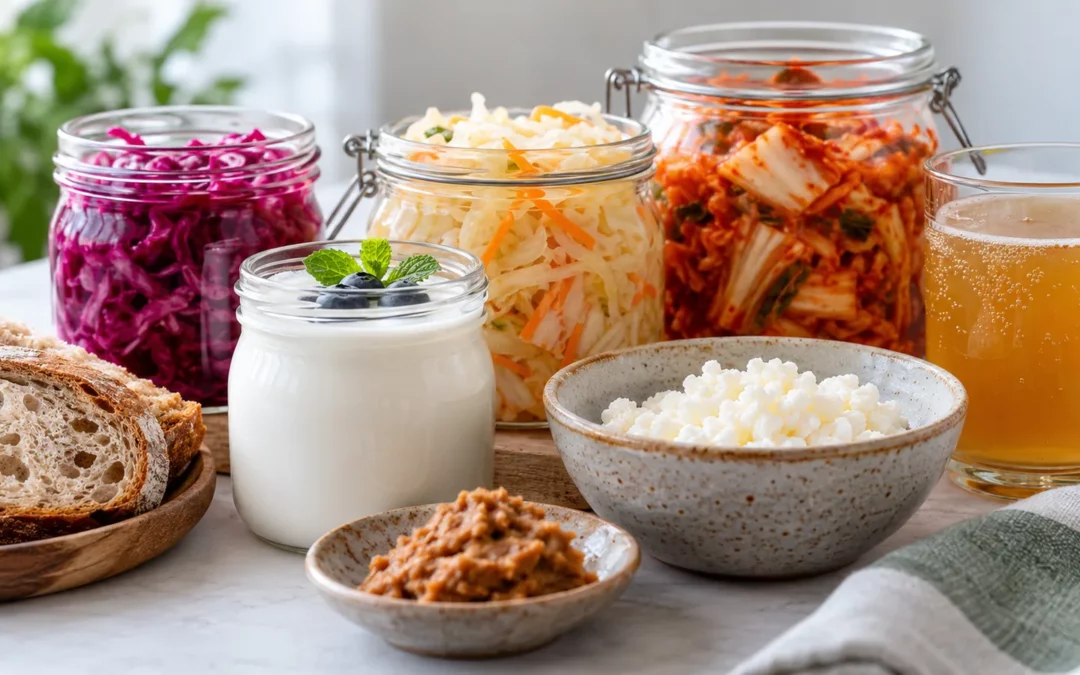
Fermented foods and probiotics: they’re not quite the same thing!
Yoghurt.
Kefir.
Sauerkraut.
Kimchi.
Kombucha.
Miso.
Sourdough bread.
They all regularly appear on lists of:
“probiotic foods you should eat to look after your microbiota”.
But there is a problem.
Not all of them are necessarily probiotic foods.
In fact, some fermented foods don’t even contain live microorganisms by the time they reach our plate.
Sourdough bread is a simple example: microorganisms take part in fermenting the dough, but then the bread goes into the oven.
In other products, microorganisms may be removed by filtration or inactivated by treatments after fermentation.
And in foods such as kimchi, sauerkraut or kombucha we may find live microorganisms without that automatically meaning those microorganisms are probiotics in the scientific sense of the word.
The difference may seem small.
But it matters because we are mixing up three different concepts:
fermentation, live microorganisms and probiotics.
Understanding them lets us value these foods for what they really are, without attributing properties to them that have not yet been shown.
The short answer: are all fermented foods probiotic?
No.
A fermented food is one made through the desired growth of microorganisms and the enzymatic changes they produce in the food’s components.
A probiotic, on the other hand, is a live microorganism which, when given in an adequate amount, provides a health benefit.
So:
A fermented food can contain live microorganisms and still not contain proven probiotics.
A fermented food may not contain live microorganisms when we eat it.
And probiotic microorganisms can also be added to a food that has not been fermented at all.
These categories can overlap.
But they are not synonyms.
The NIH puts it very clearly: although many fermented foods are made using microorganisms, not all of them necessarily contain probiotics with proven benefits.
What exactly is a fermented food?
In 2021, an international panel of scientists convened by ISAPP published a consensus specifically to settle this question.
They defined fermented foods and beverages as those made through:
desired microbial growth and enzymatic conversions of food components.
The word desired is important.
Because microorganisms can also grow in a food when it goes off.
But:
fermentation ≠ spoilage.
In fermentation we deliberately seek the activity of certain microorganisms to transform the food.
This can change:
- flavour;
- aroma;
- texture;
- shelf life;
- the digestibility of certain components;
- and the chemical composition of the food.
It is a technology humans have used for thousands of years, long before we knew bacteria and yeasts existed.
What do microorganisms do during fermentation?
It depends entirely on the food and the microorganisms involved.
During fermentation they can transform:
- sugars;
- proteins;
- fats;
- various plant components.
And produce substances such as:
- lactic acid;
- acetic acid;
- alcohol;
- carbon dioxide;
- aromatic compounds;
- various metabolites.
That explains some very different transformations.
Milk can become yoghurt.
Cabbage can become sauerkraut.
A dough of flour and water can ferment before becoming bread.
Soya can be turned into miso through various processes.
And sweetened tea can be fermented by communities of bacteria and yeasts to make kombucha.
The important thing is to understand that:
fermentation transforms the food.
But that still doesn’t tell us whether the end product contains a probiotic.
A fermented food may have no live microorganisms
This is probably one of the most surprising ideas.
If microorganisms are needed for fermentation, it seems logical to think:
“If it’s fermented, it has live bacteria.”
But not necessarily.
Microorganisms can do their job during production and then disappear.
Sourdough bread
Yeasts and bacteria take part in fermentation.
Then we bake the bread.
The high temperatures kill the live microorganisms.
The bread is still a food produced through fermentation.
But it is not a source of live microorganisms when we eat it.
Some fermented drinks
In certain industrial processes, microorganisms can be removed by:
- filtration;
- pasteurisation;
- other later treatments.
The ISAPP consensus notes, for example, that some wines and beers are produced through fermentation but may not contain live microorganisms in the final product.
So:
fermented does not necessarily mean “live”.
Fermentation mainly describes how the food was made.
And having live microorganisms doesn’t make something a probiotic either
Now let’s look at the other side of the problem.
Suppose we buy a chilled, unpasteurised sauerkraut.
It may well contain a large number and variety of live microorganisms.
Can we automatically call them probiotics?
No.
To talk scientifically about probiotics, we need something more.
Let’s recall the definition:
Live microorganisms which, when given in adequate amounts, provide a health benefit.
So we need to be able to establish things such as:
- which microorganisms they are;
- which strains;
- in what amount;
- what evidence there is;
- and what benefit has been shown.
In spontaneous fermentation we can find a complex microbial community whose composition changes during the process.
It may be perfectly suited to making the food.
But that doesn’t mean each of those bacteria has been characterised as a probiotic.
The ISAPP consensus uses traditional sauerkraut as an example: it may contain various strains of Lactiplantibacillus plantarum, but if those strains are not characterised, identified and given in a known amount with a proven benefit, we cannot automatically call them probiotics.
Four situations we need to learn to tell apart
We can sort out all this confusion into four categories.
1. Fermented, with no live microorganisms when eaten
Example:
sourdough bread after baking.
There were microorganisms and fermentation.
They are no longer alive when we eat the product.
2. Fermented, with live microorganisms but no proven probiotics
This can happen with certain:
- sauerkrauts;
- kimchis;
- kombuchas;
- cheeses;
- misos;
- other traditional fermented foods.
The microorganisms may be alive.
But we don’t necessarily know the strains, and there may be no studies showing a specific benefit.
3. Fermented food with probiotic microorganisms
Here we need well-identified live microorganisms to be present in an adequate amount and backed by relevant evidence.
This group is the real overlap between:
fermented + probiotic.
4. A product with probiotics that is not fermented
This is also possible.
A manufacturer can add probiotic microorganisms to:
- a drink;
- a food;
- a bar;
- certain nutritional products;
without that food having been made through fermentation.
The NIH expressly mentions this possibility.
So the real picture would be:
FERMENTED and PROBIOTIC
are two circles that can overlap.
Not a single circle.
Is yoghurt a probiotic?
We need to be quite precise here, because yoghurt is often used as an automatic example.
Yoghurt is made by fermenting milk with specific cultures, traditionally:
Lactobacillus delbrueckii subsp. bulgaricus
and
Streptococcus thermophilus.
So:
yes, it is a fermented food.
When these cultures remain alive in sufficient numbers in the product, we also have live microorganisms.
And there is even an authorised health claim in the European Union for certain yoghurts and fermented milks:
Live cultures can improve the digestion of the lactose in the product itself in people who have difficulty digesting it, provided the established conditions are met, including a minimum amount of live microorganisms.
But that still doesn’t mean:
“Every yoghurt is a probiotic that improves your microbiota.”
Nor:
“All the microorganisms in yoghurt produce every benefit associated with probiotics.”
A yoghurt may also include additional probiotic strains, and then we need to look at those specific strains.
Once again:
specific product + specific microorganism + specific benefit.
What about kefir?
Kefir is especially interesting because its fermentation usually involves a complex community of:
- lactic acid bacteria;
- acetic acid bacteria;
- yeasts;
- and other microorganisms,
depending on the culture used.
This creates huge variability between:
- traditional kefir;
- industrial cultures;
- brands;
- processes;
- homemade products.
So saying:
“Kefir contains probiotics”
may be too general.
It may contain a rich community of live microorganisms.
Some strains in certain products might meet probiotic criteria.
But to attribute a specific probiotic benefit, we need to know which microorganisms that product actually contains and in what amount.
That doesn’t take anything away from kefir as a fermented food.
It simply avoids using the word probiotic as a generic label.
And sauerkraut and kimchi?
Both are excellent examples of vegetable fermentation.
Traditionally, the microorganisms present on the raw ingredients and in the environment take part in a process during which the following change:
- acidity;
- flavour;
- texture;
- the microbial community.
If the product is not pasteurised afterwards, it may contain live microorganisms when eaten.
But we’re back to the same point:
a live microorganism does not automatically mean a probiotic.
What’s more, two sauerkrauts or two kimchis can have quite different microbial communities.
Factors include:
- raw ingredients;
- salt;
- temperature;
- duration;
- fermentation conditions;
- starting microorganisms;
- later processing.
So saying:
“Kimchi contains bacterium X at dose Y”
without analysing the specific product can be a major oversimplification.
Is kombucha a probiotic?
This is probably one of the words where the association below has been most exploited commercially:
fermented = probiotic = healthy.
Kombucha is made by fermenting sweetened tea with a community of bacteria and yeasts.
It may contain live microorganisms when drunk.
But its microbial composition can vary considerably between processes and products.
The NIH includes kombucha among fermented foods that may contain live microorganisms but whose microorganisms do not necessarily have proven probiotic benefits.
So:
Kombucha can be a fermented drink.
It may contain live microorganisms.
But that is not enough to say:
“it’s a probiotic”.
And much less to automatically attribute digestive, immune or metabolic benefits to it.
And pickles?
Here there is another very common confusion.
Not every gherkin we find in a jar has been fermented.
Vegetables can be preserved directly in:
vinegar.
In that case the acidity comes mainly from the added vinegar.
Not necessarily from a process of microbial fermentation of the vegetable.
The international consensus on fermented foods explicitly distinguishes fermented vegetables from those simply pickled in vinegar.
So:
“It’s in vinegar”
does not automatically mean:
“It’s fermented.”
A good label should help us tell which process was used.
Does fermentation mean a food is nutritionally better?
We can’t make that a universal rule either.
Fermentation can change the nutritional composition and properties of a food.
In certain cases it can:
- reduce certain sugars;
- modify proteins;
- transform plant components;
- change the availability of some nutrients;
- produce new compounds;
- influence flavour and texture;
- help with preservation.
But the result depends entirely on the food and the process.
We cannot say:
“Every fermented food is nutritionally superior to its unfermented version.”
We have to compare specific products.
A fermented food can also contain:
- high amounts of salt;
- added sugar;
- alcohol;
- or other components we need to consider within our overall diet.
The word fermented does not automatically make a food perfect either.
What do we know about fermented foods and the microbiota?
There is some very interesting research here.
One of the best-known trials was carried out by researchers at Stanford and published in 2021.
For ten weeks, a group of healthy adults followed a diet rich in fermented foods such as:
- yoghurt;
- kefir;
- fermented vegetables;
- kombucha;
while another group considerably increased their fibre intake.
In the fermented food group, the researchers observed:
- an increase in microbial diversity;
- changes in various immune parameters;
- a decrease in 19 inflammatory proteins measured in the blood.
It is a fascinating study.
But we need to interpret correctly what it shows.
What the Stanford study does NOT show
It does not show that:
“Kombucha reduces inflammation.”
It does not show that:
“Everyone should have six fermented foods a day.”
It does not show that:
“Fermented foods cure inflammatory diseases.”
Nor does it show that:
“A particular yoghurt will produce exactly these results.”
It was a relatively small intervention in healthy adults over a limited period.
In addition, people ate a variety of fermented foods, not a single product.
So the result supports something interesting:
a diet rich in a variety of certain fermented foods can change the microbiota and certain immune parameters.
That deserves further research.
But we still need much more data on:
- specific types of food;
- amounts;
- duration;
- different populations;
- mechanisms;
- long-term outcomes.
Stanford itself acknowledges that we still need to understand doses, frequency, products and individual responses better.
Do the bacteria in fermented foods stay and live in our gut?
Not necessarily.
This is another common picture:
“Because yoghurt has live bacteria, those bacteria get into my gut and become a permanent part of my microbiota.”
The reality is more complex.
Many microorganisms eaten in foods or probiotics may pass temporarily through our digestive system without settling permanently.
That doesn’t mean they can’t interact during their passage.
They could have an influence through:
- metabolites;
- interactions with resident microorganisms;
- transforming food components;
- interacting with the host’s cells.
What’s more, part of the interest of fermented foods may be related not only to live microorganisms but also to the transformations that take place during fermentation itself.
That’s why we shouldn’t reduce their possible value to:
“How many bacteria stay inside?”

So what should I look for when buying a fermented food?
It depends on what you are looking for.
If you simply want a fermented food
Check that it has actually been made through fermentation.
Not every sour, pickled or preserved product has been.
If you want live microorganisms
Look for information such as:
- “live cultures”;
- “active cultures”;
- storage instructions;
- information about later treatments.
A product pasteurised after fermentation may still be fermented but contain few or no viable live microorganisms.
If you specifically want a probiotic
We need more information:
- genus;
- species;
- strain;
- amount;
- evidence;
- storage conditions.
Exactly the same criteria we explain in our probiotic guides.
The word:
fermented
does not answer these questions on its own.
Does pasteurised mean bad?
No.
It means the product has received a treatment designed, among other things, to reduce or eliminate microorganisms.
This can increase:
- microbiological safety;
- stability;
- shelf life.
It may reduce or eliminate live microorganisms present after fermentation.
But the food still contains many of the transformations that took place during fermentation.
So:
pasteurised does not mean “bad food”.
It simply means that, if our aim was to eat live microorganisms, we need to know it is probably not equivalent to a version that keeps them.
The goal determines which feature we are looking for.
Is a homemade fermented food better?
We can’t say that either.
Homemade can mean excellent traditional foods.
But:
homemade ≠ automatically better.
Fermentation depends on properly controlling things such as:
- raw ingredients;
- hygiene;
- salt concentration where relevant;
- time;
- temperature;
- storage conditions.
An incorrect process can allow unwanted microorganisms to grow.
That’s why we shouldn’t interpret the message:
“fermented foods can be interesting”
as:
“leave any food at room temperature for a few days and it will be probiotic”.
That is not controlled fermentation.
It is taking an unnecessary risk.
If you make fermented foods at home, use reliable procedures specific to each food.
How many fermented foods should we eat?
There is currently no universal official recommendation stating:
“X servings of fermented foods a day for a healthy microbiota.”
The Stanford trial used a relatively high intake within an experimental intervention.
That does not automatically make it a dietary recommendation for the whole population.
We can include fermented foods in a healthy diet if:
- we like them;
- we tolerate them;
- they make sense within our eating pattern.
For example:
- plain yoghurt;
- kefir;
- certain fermented vegetables;
- other traditional foods.
But there is no obligation to eat them to have a healthy microbiota.
A varied plant-based diet, enough fibre and good habits are still fundamental.
Fermented foods can be one piece.
Not the whole puzzle.
A regulatory curiosity: yoghurt has an interesting exception
In Europe, health claims on foods are regulated.
We can’t freely write:
“This food improves your microbiota”
simply because it is fermented.
There is, however, a very specific authorised claim for the live cultures in yoghurt or fermented milk.
It can be stated that they improve the digestion of the lactose in the product in people who have difficulty digesting it, provided the product contains at least 10⁸ CFU per gram of the microorganisms set out in the regulation.
This example is very interesting because it shows exactly how a serious claim should work:
identified microorganisms + minimum amount + specific effect + specific population.
Not:
“Good for everything.”
The Spanish food safety agency (AESAN) points out that health claims must be backed by evidence and used only under the authorised conditions.
Seven common mistakes about fermented foods
Mistake 1. “All fermented foods contain live bacteria”
No.
Microorganisms may be removed or die during later processes.
Mistake 2. “Every live microorganism is a probiotic”
No.
We need defined microorganisms and evidence of a benefit.
Mistake 3. “All yoghurt is probiotic”
Yoghurt is fermented and may contain live cultures, but we need to distinguish these cultures from specific added probiotic strains and from specifically proven benefits.
Mistake 4. “Kefir, kimchi and kombucha are automatically probiotic”
Not necessarily.
They may contain live microorganisms that have not been characterised as probiotics.
Mistake 5. “If it’s in vinegar, it’s fermented”
No.
A vegetable preserved directly in vinegar has not necessarily been fermented.
Mistake 6. “If it’s pasteurised, it’s useless”
Not true either.
It may have lost its live microorganisms, but it is still a food transformed by fermentation.
Mistake 7. “The more fermented foods I eat, the better my microbiota will be”
We have no universal dose and no evidence to say that more is always better.
The food, amount, variety, tolerance and overall dietary pattern all matter.
The right question isn’t “does it have bacteria?”
Once we understand all this, we can assess a food much better.
Instead of simply asking:
“Does it have good bacteria?”
we can ask much more useful questions.
Has it really been fermented?
Does it contain live microorganisms when I eat it?
Do we know what those microorganisms are?
Are they identified down to strain level?
Do we know how many it contains?
Is there a proven benefit linked to them?
Depending on the answers, we will be talking about different things.
It may be:
a fermented food.
It may be:
a fermented food with live microorganisms.
It may even be:
a probiotic food.
All three can be of interest.
But they don’t mean exactly the same thing.
We don’t need to call everything interesting a “probiotic”
This may be the main idea of the article.
In recent years the word probiotic has gained a lot of commercial value.
And that has led us to try to stick it on practically any fermented product.
But there’s no need.
A food can be:
- traditional;
- tasty;
- nutritious;
- interesting because of how it is made;
- a source of live microorganisms;
- part of a healthy diet;
without needing to be called a probiotic.
Reserving the word probiotic for situations in which we can really identify the microorganisms and link them to a proven benefit does not take anything away from fermented foods.
It does exactly the opposite.
It lets us value each one for what it really offers.
Without exaggerating.
And without turning the microbiota into yet another marketing tool.
In summary
If you only remember eight ideas, make them these:
- Fermented and probiotic are not synonyms.
- A fermented food is made through desired microbial growth and enzymatic transformations of the food.
- A food can be fermented and not contain live microorganisms when we eat it.
- It can also contain live microorganisms that are not necessarily probiotics.
- To talk about probiotics, we need defined live microorganisms, given in an adequate amount and linked to a proven benefit.
- Yoghurt, kefir, kimchi, sauerkraut and kombucha should not automatically be put in the same probiotic category.
- Research on fermented foods and the microbiota is interesting, but it does not yet allow us to set a universal amount that everyone should eat.
- We don’t need to turn every fermented food into a “superfood”: it can be part of a healthy diet without extraordinary promises.
The next time you hear:
“Eat this food because it’s full of probiotics”
you might ask two questions:
Which microorganisms does it contain?
and:
What benefit has been shown with them?
If nobody can answer them, we probably know the food is fermented.
But we still don’t know whether we can call it a probiotic.


Recent Comments