

Stress and digestion: why can your gut sense how you feel?
There are times when your stomach seems to find out what is happening to you before you do.
An important interview.
An exam.
An argument.
Bad news.
A particularly difficult week.
And suddenly you notice:
- an urgent need to go to the toilet;
- loss of appetite;
- nausea;
- abdominal pain;
- a “knot” in your stomach;
- diarrhoea;
- constipation;
- bloating.
It is no coincidence.
The brain and the gut are in constant communication through what is known as the gut-brain axis.
When we perceive a threat, a worry or a highly demanding situation, our body triggers a stress response that does not only affect our thoughts.
It also changes:
- heart rate;
- breathing;
- hormones;
- the immune system;
- the activity of the autonomic nervous system;
- and digestive function.
That is why an emotion can be felt physically in the abdomen.
But we should immediately avoid the opposite conclusion:
“If I have digestive symptoms, it must be stress.”
Not necessarily.
Stress can trigger or intensify certain symptoms.
But pain, diarrhoea, constipation or nausea can also have many other causes that need to be assessed.
The connection is real.
The key is understanding how it works and how far we can attribute our symptoms to it.
The short answer: can stress really affect digestion?
Yes.
Stress can influence different gastrointestinal functions through several mechanisms:
- the autonomic nervous system;
- the hypothalamic-pituitary-adrenal axis;
- the enteric nervous system;
- gut motility;
- secretions;
- visceral sensitivity;
- the immune system;
- and possibly changes in the environment of the microbiota.
The clinical review of the gut-brain axis published in 2026 highlights that virtually every gastrointestinal organ and function can be affected by stress, and that people with irritable bowel syndrome may be particularly sensitive to its motor, sensory and secretory effects.
This means a person can experience genuine digestive symptoms in response to an emotional situation.
They are not imagining it.
What happens in the body when we are stressed?
Stress is not necessarily bad.
It is an adaptive mechanism.
If our brain interprets that there is a threat or a situation that calls for an immediate response, it activates different systems to prepare us.
Two of them are especially important.
The autonomic nervous system
It automatically regulates functions such as:
- heart rate;
- blood pressure;
- breathing;
- digestion.
It has two main branches, which we usually simplify as:
sympathetic
and
parasympathetic.
Under stress, sympathetic activity may increase and the balance with parasympathetic signals may shift.
This can change how the digestive system behaves.
The hypothalamic-pituitary-adrenal axis
It is usually abbreviated as:
the HPA axis.
When we perceive stress, the hypothalamus starts a hormonal cascade that ends with the release of glucocorticoids, mainly cortisol in humans.
This response helps the body adapt to a demanding situation.
The problem is not having a stress response.
The problem arises when activation is:
- intense;
- repeated;
- prolonged;
- or hard to switch off.
Research on the gut-brain axis considers the autonomic nervous system and the HPA axis to be two of the main routes through which the brain can change gastrointestinal function.
First consequence: stress can change motility
The digestive system is constantly moving.
The stomach empties its contents.
The small intestine moves nutrients along.
The colon moves waste.
All of this requires precise coordination of:
- muscles;
- the enteric nervous system;
- hormonal signals;
- the autonomic nervous system.
Stress can change these patterns.
And here is something that sometimes causes confusion:
it does not always change them in the same direction.
One person may say:
“When I’m nervous, I get diarrhoea.”
Another:
“When I’m stressed, I get constipated.”
Both are possible.
Different parts of the digestive system can respond differently, and there are also important individual differences.
The history of research into disorders of gut-brain interaction shows precisely that stress can change gastrointestinal activity, and that motility alone does not explain all symptoms.
So:
stress does not automatically mean a faster gut.
It can disrupt how the gut is regulated.
Why do some people get diarrhoea when they are nervous?
In certain stressful situations, colon activity may increase, leading to:
- urgency;
- more frequent bowel movements;
- looser stools.
Many people recognise this before:
- an exam;
- a performance;
- a competition;
- a trip;
- an important social occasion.
There is not necessarily an illness.
It may be a temporary response of the brain-gut axis.
But when these episodes are frequent or significantly interfere with daily life, it no longer makes much sense to simply say:
“I’m just a nervous person.”
It is worth checking whether there is an underlying digestive disorder.
And why can stress also be linked to constipation?
Because stress can disrupt motility patterns in different ways.
In addition, when we are under pressure other behaviours change too:
- we eat differently;
- we drink less water;
- we sleep worse;
- we are less physically active;
- we put off going to the toilet;
- our routines change.
So when someone links constipation to a stressful period, both of these may be involved:
direct physiological mechanisms + changes in behaviour.
It is not always possible to separate them completely.
And that is an important idea in health:
human symptoms rarely have a single cause.

Second consequence: the gut can become more sensitive
This may be one of the most important parts.
Imagine two people with exactly the same amount of gas in their gut.
One barely notices it.
The other experiences:
- pressure;
- pain;
- distension;
- urgency.
Why?
Because the size of a stimulus and how intensely we perceive it are not the same thing.
This is where the following concept comes in:
Visceral hypersensitivity
Visceral sensitivity refers to how our nervous system detects signals coming from internal organs.
In some people, these signals may be perceived more intensely.
The Rome Foundation identifies visceral hypersensitivity as one of the important mechanisms in disorders of gut-brain interaction, and explains that research moved away from an explanation based solely on motility towards models that include how the nervous system processes signals from the gut.
This can help explain something that seems strange:
“It hurts a lot, but my tests come back normal.”
Normal does not mean imaginary.
There may be a change in how the stimulus is processed, not necessarily a visible structural lesion.
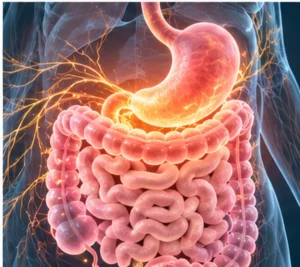
The pain is real even without a visible lesion
This needs to be said very clearly.
For years, some people with irritable bowel syndrome or other digestive disorders were told things like:
“There’s nothing wrong with you.”
Or:
“It’s psychological.”
Today we know that this interpretation is far too simple.
Disorders of gut-brain interaction can involve combinations of:
- motility;
- visceral sensitivity;
- brain processing;
- the autonomic nervous system;
- immune signals;
- microbiota;
- diet.
The Rome Foundation gradually replaced the term “functional gastrointestinal disorders” with disorders of gut-brain interaction precisely because it better describes their biology and avoids suggesting that the symptoms are not real.
The pain can be real.
Even if an endoscopy does not show an ulcer.
Third consequence: stress can change how we perceive normal signals
Our digestive system is constantly producing sensations.
Most of them go unnoticed.
Movement.
Contractions.
Distension.
Gas.
Gut contents.
But the brain is continuously filtering which information it considers relevant.
Under stress or on alert, we may pay more attention to bodily signals.
And if someone has already had painful digestive episodes, they may start to anticipate them.
For example:
“Every time I eat out, I’m going to feel unwell.”
The worry starts before the meal.
That increases physiological activation.
The person pays more attention to their abdomen.
A small sensation is interpreted as:
“Here it comes.”
And the worry grows even more.
A loop is created:
anticipation → activation → heightened perception → worry → more activation.
This does not mean the person is deliberately causing their symptoms.
It means the brain plays a part in how we perceive signals from the body.
Fourth consequence: stress can change secretions and gut function
Digestion requires coordinated secretions:
- stomach acid;
- enzymes;
- mucus;
- intestinal fluids;
- electrolytes.
The activity of the autonomic nervous system and various neuroendocrine signals can change some of these functions.
Research on disorders of gut-brain interaction has described effects of stress on gastrointestinal motility, sensitivity and secretion.
This helps us understand why a stress response can be felt in different areas:
the stomach, the small intestine or the colon.
There is no single “stress symptom”.
Fifth consequence: stress and the gut barrier
Here we need to be especially careful.
There is a great deal of talk about:
“stress = leaky gut”.
The gut barrier is a real and complex system made up of:
- epithelial cells;
- cell junctions;
- mucus;
- the immune system;
- the microbiota.
Experimental studies, especially in animals, show that different types of stress can change how this barrier works and affect immune signals.
There are also data in people with certain gastrointestinal disorders suggesting changes in permeability.
But it would be wrong to conclude:
“If you’re stressed, you have a leaky gut.”
Or:
“Tiredness and anxiety are caused by toxins crossing the gut wall.”
That explanation goes far beyond what can be shown.
Much of the detailed evidence on stress, inflammation and the barrier still comes from experimental models.
So:
there may be a connection.
That does not make “intestinal permeability” a universal diagnosis.
And what happens to the microbiota when we are stressed?
This is an area of enormous interest.
Numerous studies, especially in animals, show that different stressful situations can change:
- microbial composition;
- the metabolism of microorganisms;
- the gut environment.
There are also human studies in which situations such as:
- exams;
- military training;
- surgery;
- other stressors
have been associated with changes in the microbiota.
But interpreting this is complicated.
Because when we are stressed, we may also change our:
- diet;
- sleep;
- exercise;
- alcohol intake;
- medication;
- routines.
All of these can in turn change the microbiota.
A review on the microbiome and brain function describes this two-way relationship between the stress response and the microbiota, but much of the mechanistic evidence again comes from animal models.
That is why we should not write:
“Stress destroys your microbiota.”
It is much more accurate to say:
Stress can change the gut environment, and research is looking at how far these changes affect the composition and function of the microbiota.
So can there be “stress-induced dysbiosis”?
It is a tempting expression.
But it should be used with care.
As we explained in our microbiota guide, there is currently no single healthy microbiota composition and no universal marker that makes it easy to diagnose:
“You have dysbiosis.”
Finding microbial changes associated with stress does not mean we can run a commercial test and conclude:
“Your stress has wiped out your good bacteria.”
We are still a long way from that level of precision.
What’s more, we do not always know whether certain changes are:
- a cause;
- a consequence;
- an adaptation;
- or simply an association.
So we would only use the word dysbiosis when there is a scientific or clinical context that justifies it.
The case of irritable bowel syndrome
Irritable bowel syndrome, or IBS, is probably the best-known example of the interaction between:
the brain, the gut and stress.
This does not mean IBS is caused solely by stress.
Its pathophysiology is multifactorial.
Factors that may be involved include:
- changes in motility;
- visceral hypersensitivity;
- microbiota;
- immunity;
- previous infections;
- diet;
- central processing of signals.
But many people with IBS say their symptoms get worse during stressful periods.
The Rome Foundation considers IBS a disorder of gut-brain interaction, and current literature recognises stress as a possible important modulator of symptoms.
The distinction is essential:
stress can make IBS worse.
It does not mean:
IBS is “all in your head”.
Why do two people respond so differently to the same stress?
Because there is no single human response to stress.
Factors that play a part include:
- genetics;
- previous experiences;
- the intensity of the stress;
- its duration;
- sleep quality;
- diet;
- physical activity;
- previous digestive health;
- illnesses;
- medication;
- learning;
- sense of control.
There are also differences in how sensitive the gut-brain axis is.
One person may notice muscle tension.
Another:
a headache.
Another:
palpitations.
Another:
digestive symptoms.
That is also why we should not compare:
“I’m under a lot of stress and I never get diarrhoea, so that can’t be stress.”
Individual responses differ.
Acute stress and chronic stress are not quite the same
We also need to distinguish by duration.
Acute stress
This is a relatively short response to a specific challenge.
It can cause temporary changes in:
- appetite;
- motility;
- abdominal sensations.
When the situation passes, the body usually returns gradually to its normal state.
Chronic stress
This is a different situation.
Repeated or sustained exposure can disrupt the systems that regulate the stress response for longer.
Research has linked sustained stress to changes in:
- the HPA axis;
- autonomic regulation;
- visceral sensitivity;
- behaviour;
- sleep;
- immune function.
The 2026 clinical review also highlights that major stressful experiences, even early in life, have been associated with a higher later risk of some gastrointestinal disorders, although the exact mechanisms are still being studied.
Can reducing stress improve digestive symptoms?
For some people, yes.
Especially when there is a disorder of gut-brain interaction.
But this does not mean that:
“just relax”
is enough of a treatment.
It is probably one of the least helpful pieces of advice someone with persistent symptoms can be given.
There are, however, structured interventions aimed at brain-gut interaction.
Those that have been studied include:
- cognitive behavioural therapy;
- gut-directed hypnotherapy;
- relaxation techniques;
- stress management strategies.
The fact that brain-directed treatments can improve gut symptoms does not mean those symptoms are psychological.
It means we are working on one of the system’s communication pathways.
Just as we can act from the gut towards the brain, we can also act from the brain towards the gut.

Does deep breathing fix your microbiota?
No.
This is another trend that has been oversimplified.
Slow breathing, relaxation or certain practices can help some people reduce physiological activation or manage stress better.
That can be useful.
But we should not turn it into:
“Five breaths activate the vagus nerve, repair your gut and balance your microbiota.”
Vagal and autonomic physiology is far more complex.
We can use relaxation techniques for their effects on wellbeing and physiological regulation without attributing mechanisms to them that have not been shown.
What about probiotics for stress?
It is a very interesting area of research.
There are trials on specific strains and combinations in relation to:
- perceived stress;
- anxiety;
- mood;
- sleep;
- various physiological markers.
Some results are promising.
Others show no meaningful differences.
And the formulations used vary widely.
So:
there is no general category of “probiotics for stress” that can be treated as interchangeable.
We need to ask again:
- which strain?
- what dose?
- which population?
- for how long?
- what outcome?
- how good was the study?
It is exactly the same approach we have used throughout this series.
Stress does not explain every digestive symptom either
This section should be part of any serious article on this subject.
It is very easy for someone with abdominal pain to read:
“Stress affects the gut.”
and conclude:
“It must be stress.”
But digestive symptoms can be linked to many different conditions.
These include:
- infections;
- intolerances;
- coeliac disease;
- inflammatory bowel disease;
- side effects of medication;
- biliary disorders;
- pancreatic problems;
- metabolic diseases;
- various gastrointestinal disorders.
So a link in time with stress does not rule out other causes.
When to see a professional
It is a good idea to seek professional advice when symptoms are:
- persistent;
- recurrent;
- severe;
- new and unusual;
- or have a significant impact on your quality of life.
And especially if you notice signs such as:
- blood in your stools;
- unintentional weight loss;
- fever;
- persistent vomiting;
- anaemia;
- severe pain;
- difficulty swallowing;
- ongoing diarrhoea;
- significant night-time symptoms;
- persistent changes in bowel habits.
The aim is not to cause alarm.
It is not to use:
“it’s probably just nerves”
as a substitute for a diagnosis.
What can we do if we notice stress is affecting our digestion?
We can start by looking for patterns.
Not by diagnosing.
Ask yourself:
When do the symptoms appear?
Before specific situations.
During demanding periods at work.
After a poor night’s sleep.
What else changes at the same time?
Diet.
Coffee.
Alcohol.
Routines.
Physical activity.
What exactly are the symptoms like?
Pain.
Diarrhoea.
Constipation.
Nausea.
How long do they last?
Hours.
Days.
Weeks.
Do they go away when the stress eases?
This information can be very useful to a healthcare professional.

Habits that make sense without promising miracles
We can work on several factors at once.
Keep reasonably regular mealtimes
Especially if stress makes you alternate between skipping meals and eating large amounts.
Don’t automatically increase coffee and stimulants
When we are tired and stressed, it is common to have more caffeine.
In some people, this can make digestive symptoms, sleep and feelings of anxiety harder to manage.
Stay physically active
Not because it “detoxes” the gut.
But because it is part of a healthy pattern and can help with managing stress.
Sleep
Sleep and the stress response are closely linked.
A bad night can make us less able to cope the next day with both psychological demands and certain physical sensations.
Don’t cut out foods indiscriminately
When digestive symptoms appear, it is common to start cutting out:
gluten.
lactose.
fruit.
pulses.
fermented foods.
fibre.
Each one may seem logical.
But cutting out many foods without assessment can make eating more complicated and create more worry around food.
Ask for help if the stress is ongoing
You don’t have to manage everything on your own.
If there is significant anxiety, chronic stress or a considerable impact on quality of life, psychological support can very well be part of the treatment.
Five myths about stress and digestion
Myth 1. “If stress affects my gut, my symptoms are psychological”
No.
They are physical symptoms modulated by systems that connect the brain and the gut.
Myth 2. “Stress causes all digestive diseases”
No.
It can influence certain symptoms and diseases, but it does not on its own explain every gastrointestinal problem.
Myth 3. “If my tests are fine, then there’s nothing wrong with me”
No.
Disorders of gut-brain interaction can cause significant symptoms without a visible structural lesion.
Myth 4. “Stress destroys the microbiota”
That is too simplistic.
There are interesting associations and experimental mechanisms, but the microbial response is complex.
Myth 5. “A probiotic can get rid of stress”
No.
Some strains are being studied in this context, but a supplement is no substitute for proper stress management or for psychological or medical treatment when needed.
The stress-gut loop
One of the best ways to understand this topic is to picture a loop.
A person is stressed.
Stress increases certain digestive symptoms.
The symptoms cause worry:
“What can I eat?”
“What if it hurts when I go out?”
“What if I can’t find a toilet?”
The worry increases activation.
The person avoids situations.
They pay even more attention to their abdomen.
The symptoms take up more and more space in their life.
The loop continues.
Breaking it may mean acting at different points:
- diet;
- symptoms;
- habits;
- stress;
- how sensations are interpreted;
- medical treatment;
- psychological support.
There is not necessarily a single lever.
And that is precisely the essence of the gut-brain axis.
In summary
If you only remember eight ideas, make them these:
- Stress can genuinely change digestive function.
- It can affect motility, visceral sensitivity, secretions and neuroendocrine regulation.
- Not everyone responds in the same way: some people may get diarrhoea and others constipation.
- Stress can increase visceral sensitivity, so that normal gut stimuli are felt more intensely.
- The symptoms of disorders of gut-brain interaction are real even when there is no visible structural lesion.
- There is research on stress, the gut barrier and the microbiota, but we should not turn it into universal explanations about “leaky gut” or “stress-induced dysbiosis”.
- Managing stress can be part of the approach to certain digestive problems, but it does not replace medical assessment when there are persistent symptoms or warning signs.
- The aim is not to decide whether a problem is:
“in your gut”
or:
“in your head”.
The aim is to understand that both systems are in constant communication.
Perhaps that is why the expression:
“I can feel it in my stomach”
is far more scientific than it seemed.


Recent Comments