
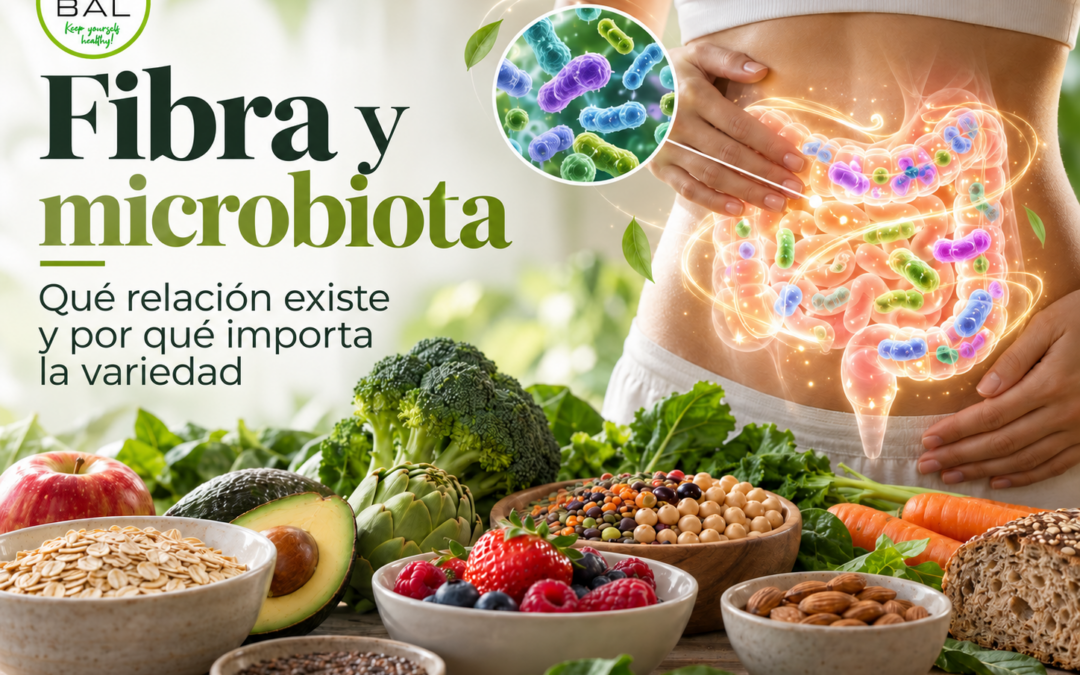
Fibre and the microbiota: how are they connected and why does variety matter?
When we talk about caring for the gut microbiota, one recommendation comes up again and again:
eat more fibre.
It’s a good starting point.
But it’s incomplete.
Because fibre is not a single substance, and our gut doesn’t contain a single bacterium waiting to be fed.
Under the term dietary fibre we group together components with very different structures and properties.
Some absorb water.
Others form gels.
Some are easily fermented by certain gut microorganisms.
Others ferment slowly.
And some are hardly used by the microbiota at all, but can still play important roles in bowel transit or stool bulk.
That’s why two people can eat exactly the same amount of fibre and be giving their digestive system quite different combinations.
And there is another important factor:
variety.
An apple, lentils, oats, almonds and broccoli don’t contain exactly the same types of fibre or the same plant compounds.
This helps explain why, when it comes to the microbiota, it may make more sense to think in terms of:
amount + variety + tolerance
rather than simply chasing a number of grams.
The short answer: how are fibre and the microbiota connected?
Part of the fibre we eat is not digested by our enzymes in the small intestine.
So it reaches the large intestine.
There, certain microorganisms can use some of these components as a substrate and ferment them.
During this process various metabolites can be produced, including short-chain fatty acids such as:
- acetate;
- propionate;
- butyrate.
These compounds are involved in various functions related to the gut environment and communication between the microbiota and the body.
But not all fibres are equally fermentable, nor do they produce exactly the same responses.
Their effects depend on characteristics such as:
- chemical structure;
- viscosity;
- solubility;
- particle size;
- degree of fermentability;
- the food they come from;
- and the person’s microbiota.
A broad review on diet and the microbiota found that the associations between carbohydrates, fibre and microorganisms varied depending on the type of carbohydrate and its food source.
That’s why simply saying:
“fibre feeds the microbiota”
is correct as a rough approximation.
But there’s still a lot to explain.
What exactly is dietary fibre?
We use the term fibre for certain food components that fully or partly resist digestion in the small intestine.
Most of it comes from plant foods.
We can find fibre in:
- vegetables;
- fruit;
- pulses;
- wholegrains;
- nuts;
- seeds.
But these fibres are not identical.
They include, for example:
- cellulose;
- pectins;
- beta-glucans;
- arabinoxylans;
- various hemicelluloses;
- resistant starch;
- inulin;
- fructooligosaccharides.
Each has different properties.
For a long time we have explained fibre by dividing it mainly into:
soluble
and:
insoluble.
The distinction is still useful.
But we know it is not enough to explain what happens in the gut.
A recent review on fibre classification highlights that solubility alone does not determine fermentability. Properties such as structure, molecular weight and particle size can also change how a fibre interacts with the microbiota.
So when we talk about the microbiota, we may need to look at more than whether a fibre “dissolves in water”.
Soluble and insoluble fibre: useful, but too simple
The traditional classification goes roughly like this:
Soluble fibre
It can disperse or dissolve in water.
Some soluble fibres can form viscous solutions and many are fermentable.
Insoluble fibre
It doesn’t dissolve easily in water.
Some types contribute especially to stool bulk and bowel transit.
The problem arises when we turn this into:
“Soluble fibre feeds bacteria and insoluble fibre is only good for going to the toilet.”
That isn’t correct either.
Fermentability and solubility are different properties.
There are soluble fibres that are poorly fermentable and fibres considered insoluble that can be partly fermented.
In addition, characteristics such as:
- viscosity;
- water-holding capacity;
- structure;
- accessibility to microbial enzymes
can be very relevant.
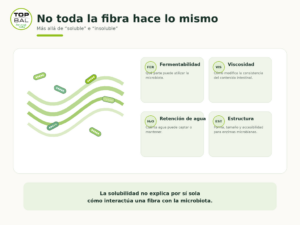
That’s why it increasingly makes sense to talk about what a fibre does rather than just putting it into one of two boxes.
What does it mean for a fibre to be fermentable?
It means certain gut microorganisms can use it as a metabolic substrate.
We don’t have all the enzymes needed to break certain bonds found in some carbohydrates.
Our microorganisms can have those tools.
When a fermentable fibre reaches the colon, some bacteria can break it down.
But not all bacteria can use all types of fibre.
This is fundamental.
Imagine our microbiota as a city.
Instead of always sending the same shipment of raw materials, a varied diet delivers:
- pectins;
- beta-glucans;
- resistant starches;
- arabinoxylans;
- oligosaccharides;
- and many other compounds.
Different microorganisms have different abilities to make use of them.
In addition, the fermentation products generated by some bacteria can then be used by others.
This is known as cross-feeding.
That’s why the fibre-microbiota relationship works more like a network than like:
fibre X → bacterium Y.
The ecosystem is much more complex.
What do bacteria produce when they ferment fibre?
Among the most studied products are short-chain fatty acids.
The three main ones are:
Acetate
The most abundant, it can take part in various metabolic processes.
Propionate
It can be absorbed and take part in various metabolic pathways.
Butyrate
Especially interesting because it is an important source of energy for the cells of the colon.
A 2024 review on colonic fermentation describes how the fermentation of carbohydrates and fibre contributes to the production of these fatty acids and highlights the role of butyrate in the colonic epithelium.
But there is something important:
We shouldn’t turn:
“fibre fermentation can produce butyrate”
into:
“the more fibre you eat, the more butyrate you’ll produce and the better you’ll be”.
The microbiota doesn’t follow such a simple linear rule.
The type of fibre matters.
The amount matters.
The microbial composition matters.
And so does the metabolic capacity of that community.
So how much fibre do we need?
EFSA states that a daily intake of 25 grams of fibre is adequate for normal bowel function in adults. It also notes that higher intakes are associated with other health benefits.
It’s a useful reference.
But we need to understand what it means.
It doesn’t mean:
“25 grams guarantees a perfect microbiota.”
Nor:
“24 grams is not enough and 25 is optimal.”
It is a population nutrition reference related to bowel function.
The microbiota adds another dimension.
Two diets can both provide 25 grams of fibre and be completely different.
Diet A
Most of it always comes from the same two foods.
Diet B
The fibre comes from:
- vegetables;
- pulses;
- fruit;
- oats;
- wholemeal bread;
- nuts;
- seeds.
They could add up to similar amounts.
But the variety of structures and other plant compounds reaching the gut would not necessarily be the same.
And that brings us to the next question.
Why might variety matter?
Because different foods provide different combinations of:
- fibres;
- resistant starches;
- polyphenols;
- micronutrients;
- plant structures.
So a varied plant-based diet exposes the microbiota to a wider range of substrates.
A systematic review on diet and the microbiota found that a higher fibre intake was often associated with changes in various microbial groups, and that the response varied depending on the source and type of carbohydrate.
This doesn’t mean we can say:
“each plant feeds a different bacterial species.”
Reality is not that tidy.
Several microorganisms can use similar substrates.
One microorganism can use different substrates.
And interactions between species make the outcome even more complicated.
But the general idea makes sense:
a monotonous diet provides a narrower range of substrates than a diverse plant-based diet.
Where does the idea of eating 30 different plants a week come from?
This recommendation has become hugely popular.
And it’s worth explaining where it comes from, because it is often presented too categorically.
The number comes mainly from the American Gut Project, a huge citizen science project that analysed microbiota samples and dietary data from thousands of participants.
Among other groups, researchers compared people who reported eating:
10 or fewer types of plants per week
with:
more than 30 types.
They found differences in microbiota composition between the two groups and in certain microbial markers.
It’s a very interesting result.
But there are three things we need to clarify.
- It was an observational study
Finding an association does not show that the number 30 is the direct cause of all the changes observed.
People who eat 30 different plants may also differ in other habits.
- The study compared extremes
Fewer than 10 versus more than 30.
That doesn’t show there is a special biological effect when going:
from 29 to 30.
- “30” is not an official clinical recommendation
There is no established weekly “30 plants” dose equivalent to the official fibre recommendations.
So:
30 plants can be an interesting practical challenge to encourage variety.
But it shouldn’t become a new nutritional obsession.
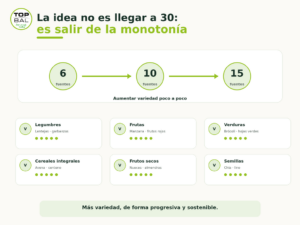
The important thing isn’t reaching 30: it’s breaking the monotony
Someone who currently eats six different plant foods a week doesn’t need to obsess about reaching exactly thirty tomorrow.
A more useful goal might be to go from:
6 → 10.
Then:
10 → 15.
And keep increasing variety within a diet you can stick to.
You can add variety in simple ways.
If you usually have oats for breakfast:
add walnuts and berries.
If you always eat rice:
alternate with oats, barley, quinoa or other grains to suit your taste.
If you don’t eat many pulses:
try lentils, chickpeas, beans or peas.
If you always have the same salad:
change the leaves, vegetables, seeds and other ingredients.
This doesn’t need to become a spreadsheet.
The aim is to gradually broaden your repertoire.
Do all fibres feed the same bacteria?
No.
And this is one of the best reasons to diversify.
Different microorganisms have different sets of enzymes capable of breaking down carbohydrates.
For example, research on fibres such as inulin and arabinoxylan shows different metabolic and microbial responses.
A Stanford intervention study compared different fibres and found that their effects were not interchangeable, and that there was also considerable variability between people.
This dismantles two ideas.
First:
“All fibre does the same thing.”
No.
Second:
“A particular fibre will have exactly the same effect on everyone.”
Not that either.
Our starting microbiota shapes, at least in part, how we respond to certain substrates.
Which foods help us include different types of fibre?
We don’t need to memorise the chemical composition of every food.
We can think in terms of food families.
Pulses
Lentils, chickpeas, beans and peas provide fibre, resistant starch and various carbohydrates that the microbiota can use.
Wholegrains
Oats, barley, wholewheat, rye and other grains can provide beta-glucans, arabinoxylans and various plant cell wall components, depending on the grain.
Fruit
Apples, pears, berries, citrus fruit and many others provide different fibres, including pectins, as well as polyphenols and other compounds.
Vegetables
They offer an enormous variety of plant structures and fibres.
Nuts
Almonds, walnuts, hazelnuts, pistachios and others provide fibre as well as unsaturated fats and other components.
Seeds
Chia, flax, sesame and other seeds broaden the variety even further.
The idea is not to find:
“the number one food for the microbiota”.
That’s probably the wrong question.
It makes more sense to build an eating pattern where different sources of fibre appear regularly.
What about resistant starch?
It deserves a special mention.
We usually think of starch as a carbohydrate we digest.
But certain starches resist digestion in the small intestine and reach the colon in larger amounts.
This is what we call resistant starch.
There are several types, and they can be found in various foods and preparations, including:
- pulses;
- certain grains;
- slightly green bananas;
- and some starchy foods after certain cooking and cooling processes.
We don’t need to turn this into another nutrition trick:
“Cool everything you eat to hack your microbiota.”
The important thing is to understand that the structure and preparation of foods can change how much carbohydrate reaches the colon in an accessible form.
One more reason why talking only about “grams of fibre” doesn’t tell the whole story.
Is all fermentable fibre prebiotic?
No.
We saw this difference in the article on probiotics and prebiotics.
A prebiotic must be a substrate selectively used by host microorganisms, and that use must provide a proven benefit.
So:
fermentable fibre ≠ automatically prebiotic.
ISAPP explicitly maintains this distinction and points out that some fibres have a special status precisely because their benefit comes through selective use by certain microorganisms.
Among the most studied prebiotics are certain:
- FOS;
- GOS;
- inulin;
- and other specific substrates.
But a diet rich in a variety of fibre is still worthwhile even if we don’t label each food as “prebiotic”.
We don’t need to turn our whole diet into a commercial classification.
Does more microbial diversity always mean better health?
Here, too, it pays to be cautious.
It’s true that many studies find associations between certain eating patterns and greater microbial diversity.
For example, a 2024 systematic review of 37 studies on the Mediterranean diet found that 24 of them (10 observational and 14 interventional) reported an association between greater adherence and microbiota diversity.
But even in this field the results are not completely uniform.
An earlier review of the Mediterranean diet had already pointed out considerable heterogeneity between studies and a lack of fully consistent results.
What’s more:
more diversity is not automatically better in every context.
There are physiological states and clinical situations where simply interpreting a diversity index can be misleading.
That’s why the goal of eating a varied diet shouldn’t be:
“raising my microbial diversity score.”
The recommendation can be supported by something much more solid:
a varied diet of plant foods provides different fibres, nutrients and bioactive compounds and is part of healthy eating patterns.
If it also has a positive effect on certain functions of the microbiota, so much the better.
What happens if I increase fibre a lot all at once?
You may experience:
- wind;
- bloating;
- changes in bowel habits;
- abdominal discomfort.
Especially if someone who ate little fibre suddenly starts eating large amounts of:
- pulses;
- bran;
- inulin;
- fibre supplements;
- highly fermentable foods.
This doesn’t automatically mean that:
“fibre doesn’t agree with me”
nor that:
“you have to put up with it because wind means your microbiota is healing”.
Neither conclusion is a good one.
Tolerance matters.
For many people it may be sensible to increase the amount and variety gradually, giving the digestive system time to adapt.
Hydration also deserves attention, especially when increasing certain types of fibre.
What if I have irritable bowel syndrome or other digestive symptoms?
Here we need to be even more careful with general messages.
A recommendation such as:
“Eat as much fibre as you can”
may be unsuitable for some people.
Not all fibres have the same effect on:
- wind;
- distension;
- stool consistency;
- transit speed.
In people with digestive symptoms, choosing the type and amount of fibre may need to be tailored to the individual.
At the same time, cutting out whole food groups indiscriminately for long periods is not necessarily a good strategy either.
If you have:
- recurrent abdominal pain;
- severe bloating;
- persistent diarrhoea;
- significant constipation;
- weight loss;
- blood in your stools;
- or symptoms that significantly affect your quality of life,
the aim shouldn’t simply be to:
add more fibre.
First you need to understand what is going on.
Is it better to get fibre from food or from supplements?
As a general rule, food should be the foundation.
A plant food doesn’t just provide fibre.
Depending on the food, it also provides:
- vitamins;
- minerals;
- polyphenols;
- protein;
- fats;
- water;
- plant structures;
- other compounds.
In addition, eating different foods provides different types of fibre.
A supplement has a different advantage:
it can provide a specific amount of a particular fibre.
That can be useful in certain contexts.
But it doesn’t automatically make the supplement equivalent to a varied plant-based diet.
We may need a particular fibre for a particular goal.
But that doesn’t remove the importance of diet.
Once again:
supplementing doesn’t mean replacing.
A simple strategy to increase variety without complicating your diet
We don’t need to change our whole diet tomorrow.
We can use a much more reasonable rule:
Add before you remove
Before asking yourself:
“What do I need to stop eating?”
try asking:
“Which different plant food can I add?”
For example:
Breakfast
Oats + berries + walnuts.
That’s already three different sources.
Lunch
Lentils + onion + carrot + tomato.
We’ve added four more.
Snack
A piece of fruit.
Dinner
Different vegetables + wholemeal bread + seeds.
Without turning eating into an exam, we have considerably broadened the variety.
Over the week we can alternate:
- colours;
- grains;
- pulses;
- nuts;
- fruit;
- vegetables;
- seeds.
There’s no need to eat thirty ingredients in one day.
The idea of variety makes sense over time.
Five common mistakes when we talk about fibre and the microbiota
Mistake 1. “All fibre does the same thing”
No.
Different fibres have different physical properties and different degrees of fermentability.
Mistake 2. “All fibre is prebiotic”
No.
Prebiotic is a more specific category that requires selective use and a proven benefit.
Mistake 3. “The more fibre, the better”
Not necessarily.
Amount, type, tolerance and context matter.
Mistake 4. “You have to eat exactly 30 plants a week”
No.
It’s a practical idea derived from an observational association, not a clinical dose.
Mistake 5. “If my microbiota is diverse, I’m healthy”
Diversity is an interesting characteristic, but it is not on its own a diagnosis of gut health.
The real advantage of variety
We can become obsessed with looking for:
the best fibre.
But perhaps we’re asking the wrong question.
Our gut doesn’t receive isolated nutrients.
It receives meals.
And our microbiota isn’t made up of a single species.
It’s an ecosystem made up of communities that interact and share resources.
That’s why it makes sense that a diet regularly based on:
- pulses;
- fruit;
- vegetables;
- wholegrains;
- nuts;
- seeds;
provides a much wider range of substrates than an extremely repetitive diet.
We don’t need to know which bacterium eats each molecule of our dinner.
We need to build a reasonably diverse food environment.
And that brings us back to a rather unspectacular but very useful idea:
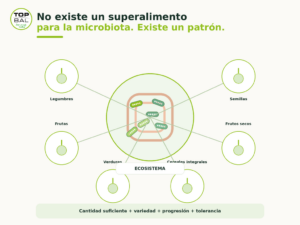
there is no superfood for the microbiota.
There is a pattern.
In summary
If you only remember seven ideas, make them these:
- Fibre is not a single substance. There are many types with different properties.
- Part of the fibre reaches the colon and can be fermented by certain microorganisms.
- This fermentation can produce metabolites such as acetate, propionate and butyrate.
- Not all fibres are equally fermentable and not all fibre is prebiotic.
- EFSA considers 25 grams a day an adequate intake for normal bowel function in adults, but that figure alone does not define an optimal microbiota.
- A variety of plant sources can provide a wider range of fibres and other compounds, but there is no evidence to treat “30 plants a week” as a mandatory threshold.
- To care for the microbiota, it probably makes more sense to think about enough + variety + gradual progress + tolerance than to obsess over a single food or supplement.
Perhaps the useful question isn’t:
“Which fibre is best for my microbiota?”
But:
“How many different plant foods are really part of my usual diet?”
The answer may tell us a lot more.


Recent Comments