

What is a probiotic strain and why does identifying it matter?
If you have ever read the label of a probiotic, you have probably come across names like:
Lacticaseibacillus rhamnosus GG
Bifidobacterium animalis subsp. lactis BB-12
Limosilactobacillus reuteri DSM 17938
At first glance they look like unnecessarily complicated scientific names.
Why not just write:
Lactobacillus
or:
Bifidobacterium?
Because we would be losing a fundamental piece of information.
When we talk about probiotics, it isn’t enough to know that a product contains a certain “family” of bacteria.
Even knowing the species isn’t always enough.
In many cases we need to know which specific strain it contains.
And this isn’t just microbiologists being obsessive.
Identifying the strain allows us to link the microorganism in front of us with:
- the studies that have been carried out;
- the dose used;
- its characteristics;
- its safety;
- and the possible benefits investigated.
That’s why two products can apparently contain the same species and yet not necessarily have the same evidence behind them.
The question:
“Does it contain Lactobacillus rhamnosus?”
may not be enough.
A much better question would be:
“Which strain of Lacticaseibacillus rhamnosus does it contain?”
Let’s see why.
The short answer: what is a probiotic strain?
A strain is a specific population of microorganisms within a species that has a genetic identity and certain characteristics that distinguish it from other strains of the same species.
In a probiotic, put simply, we may find this identification:
genus → species → strain
For example:
Lacticaseibacillus → genus
rhamnosus → species
GG → strain
Sometimes there is also a subspecies.
The NIH explains that probiotic microorganisms should be identified by genus, species and strain.
Why so much precision?
Because two strains belonging to the same species can have genetic and functional differences.
This means the results obtained by studying one specific strain should not automatically be applied to any other strain of the same species.
This is the central idea of the whole article.
Genus, species and strain: a simple comparison
Microbiology can seem complicated because we use unfamiliar names.
We can make it much simpler.
Imagine an address:
Spain → Barcelona → Passeig de Gràcia 50
Just saying:
“It’s in Spain”
gives us some information.
Saying:
“It’s in Barcelona”
gets us much closer.
But we still haven’t identified the exact place.
The strain would be like finally arriving at:
Passeig de Gràcia 50.
In microbiology:
genus identifies a broad group.
species narrows it down much more.
strain identifies a particular microorganism or lineage within that species.
For example:
Lacticaseibacillus rhamnosus GG
and another strain of:
Lacticaseibacillus rhamnosus
belong to the same species.
They share many characteristics.
But we shouldn’t assume they are identical.
The Australian regulator TGA describes a strain as a microbial population descended from a specific isolate or culture, and notes that different strains of the same species can differ in both genes and observable characteristics.
That explains why we need to read the name right to the end.

An example: Lacticaseibacillus rhamnosus isn’t necessarily enough
Suppose we find an interesting scientific study carried out with:
Lacticaseibacillus rhamnosus GG
We may also find a supplement whose label simply says:
Lacticaseibacillus rhamnosus
Can we say that product will automatically produce the same result?
No.
We are missing information.
We don’t know whether it contains the GG strain.
It could contain a different strain of the same species.
The mistake would be like studying a particular grape variety and concluding that every grape in existence will have exactly the same characteristics.
Belonging to the same species provides important information.
But not necessarily all the information we need.
The World Gastroenterology Organisation considers that the most robust way to link evidence for a probiotic with a specific benefit is to tie it to specific strains or combinations of strains used at the effective dose.
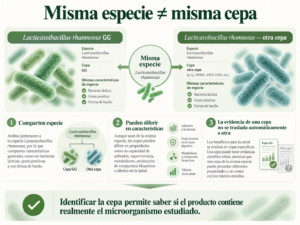
What can differ between two strains of the same species?
Much less than between completely different species, of course.
But enough to matter.
Different strains may differ in terms of:
- certain genes;
- how they use nutrients;
- the metabolites they produce;
- tolerance to acid;
- tolerance to bile salts;
- how they interact with other bacteria;
- the production of certain substances;
- interaction with the host’s cells;
- behaviour during manufacturing and storage.
This doesn’t mean absolutely everything is different between two strains.
They share a huge number of characteristics precisely because they belong to the same species.
But certain differences may be relevant to the function being studied.
That’s why identifying a strain allows us to check:
Is it really the microorganism that was used in the research?
Without that identification, the link between product and study becomes much weaker.
But be careful: not every effect has to be unique to one strain
Here we need to add an important nuance.
We could go from one oversimplification:
“All lactobacilli do the same thing.”
to the opposite oversimplification:
“Absolutely every probiotic effect is exclusive to a single strain.”
That wouldn’t be correct either.
The World Gastroenterology Organisation explains that certain properties and mechanisms may be shared between different strains, species and even genera.
For example, different microorganisms may share abilities related to:
- producing certain metabolites;
- changing gut pH;
- interacting with other microorganisms;
- certain effects on transit;
- resistance to colonisation by external microorganisms.
So biology can share mechanisms.
What we need to avoid is automatically extrapolating a specific clinical benefit without checking the evidence.
The WGO itself notes that, when there is a well-established shared mechanism responsible for the effect studied, it may make sense to analyse different strains together. When there is no such justification, the evidence should be interpreted at strain level.
This nuance matters.
Science hardly ever works well with absolute rules.
So why do we insist so much on identifying the strain?
Because it allows us to build a chain of evidence.
Imagine:
Step 1
A research team selects a particular strain.
Step 2
It identifies it correctly.
Step 3
It carries out studies using a specific amount.
Step 4
It assesses certain outcomes in a particular population.
Step 5
It publishes the results.
Now a commercial product appears.
To reasonably link that product with the studies, we should be able to check:
Does it contain the same strain?
In a comparable amount?
Does the formulation keep it viable?
Is it used in a comparable way?
If we don’t know the strain, we have already lost the first link in the chain.
That’s why writing:
“contains a strain of Bifidobacterium animalis”
provides much less traceability than:
“contains Bifidobacterium animalis subsp. lactis BB-12″.
What do letters and numbers like GG, BB-12 or DSM 17938 mean?
They are not doses.
They are not CFU.
And they don’t indicate that one strain is necessarily better than another.
They are designations that allow it to be identified.
Some strains use commercially known names or codes.
Others appear linked to numbers from international collections of microorganisms.
For example, the WGO shows cases such as:
Lacticaseibacillus rhamnosus GG — ATCC 53103
or:
Bifidobacterium animalis subsp. lactis DN-173 010 — CNCM I-2494
In these examples, the same strain may appear linked to a designation used in research and to a deposit number in a recognised collection.
Scientific organisations such as the WGO and consensus documents on probiotic criteria recommend that strains be deposited in recognised international collections.
This improves something fundamental:
traceability.
It makes it possible to know more precisely which microorganism was studied and to keep a reference of that strain.
What is a culture collection?
We can think of it as a kind of library of microorganisms.
Specialised institutions keep cultures that are fully identified and preserved.
Well-known collections include:
- ATCC;
- DSMZ;
- CNCM;
- NCIMB;
- among others.
When a strain is deposited in one of these collections, it receives a reference.
This makes the following easier:
- identification;
- preservation;
- scientific reproducibility;
- traceability;
- comparison between studies.
It doesn’t mean every deposited strain is automatically a good probiotic.
The deposit identifies the microorganism.
It doesn’t in itself prove a benefit.
We still need evidence.
But it allows us to answer an essential question:
“Exactly which microorganism are we talking about?”
Identifying a strain doesn’t mean proving it works
This point deserves its own section.
A label could be impeccable:
correct genus.
correct species.
strain perfectly identified.
And still not show the benefit we are looking for.
Why?
Because identity and effectiveness are different questions.
Identification answers:
Which microorganism is it?
Clinical research answers:
What happens when we give it to people, at this dose and for this purpose?
We need both.
A perfectly identified strain without relevant research still has limited evidence to support certain claims.
And an excellent study on one strain doesn’t automatically justify a product that contains a different one.
So our chain should be:
identity → dose → evidence → formulation → purpose.
Not:
scientific name → guaranteed benefit.
What role does the dose play?
A huge one.
Even when we have correctly identified a strain, we still need to know:
how much are we giving?
Suppose we find trials with a particular strain using a specific dose.
Now we find a product that contains the same strain.
Great.
But the daily amount is a hundred times lower than the one used in the studies.
Can we assume the same result?
Not necessarily.
That’s why the WGO insists on linking the evidence not only to the strain but to the effective dose studied.
This is another reason why it isn’t enough to say:
“Our product contains strain X, which has been scientifically studied.”
The sentence we should look into is much more complete:
“Does it contain strain X in an amount related to the evidence being used to justify this purpose?”
Now that’s a serious question.
And in products with many strains?
This is where things get even more interesting.
Imagine a product with ten strains.
The label says:
50 billion total CFU.
We know roughly how many microorganisms the full dose contains.
But we may not know how much of each strain it provides.
Are there 5 billion of each?
Are there 40 billion of one and very small amounts of the others?
We can’t work it out if it isn’t stated.
And another question arises:
Have the strains been studied individually, or also together?
A combination may make sense.
But putting together ten strains studied separately doesn’t automatically show that the combination produces the sum of all the individual effects.
It may work.
It may work differently.
It may provide no additional benefit.
We need to assess the formulation.
So:
identifying all the strains is the start of the analysis, not the end.
Why have some Lactobacillus names changed?
This can be quite confusing when looking for studies.
For decades, many well-known probiotic bacteria belonged to the huge genus:
Lactobacillus.
In 2020, scientists revised its classification because this genus grouped together microorganisms that were genetically too diverse.
As a result, many new genera were created.
For example:
Lactobacillus rhamnosus
became:
Lacticaseibacillus rhamnosus
Lactobacillus plantarum
became:
Lactiplantibacillus plantarum
and:
Lactobacillus reuteri
became:
Limosilactobacillus reuteri.
The important thing is that the bacterium didn’t change.
The way we classify it did.
The species and strain designations stayed the same.
ISAPP recommends searching for some strains using both their old and current names when looking through the scientific literature.
This explains why you may find:
Lactobacillus rhamnosus GG
in an older study
and:
Lacticaseibacillus rhamnosus GG
in more recent information.
It’s the same strain with an updated taxonomic classification.
Does a label with the old name mean the product is bad?
Not necessarily.
Updated scientific names can take time to make it onto labels, documentation, databases and marketing materials.
So finding an old name does not in itself show there is a quality problem.
But a company that works seriously with probiotics should be able to identify precisely:
- the microorganism;
- the current nomenclature;
- the historical name where necessary;
- the strain;
- the associated documentation.
Transparency matters again.
We don’t need consumers to memorise twenty new bacterial genera.
We need them to be able to know what they are taking.
How can you tell whether a product identifies its strains correctly?
Look at the composition.
Good scientific information should let you find something like:
Lacticaseibacillus rhamnosus GG
rather than just:
Lactobacillus
or:
a blend of lactobacilli.
In multi-strain products we should ideally be able to identify every microorganism in the formula.
The WGO considers that, from a scientific perspective, a probiotic label should include:
- genus;
- species;
- subspecies where relevant;
- strain designation;
- the viable count of the strains at the end of shelf life;
- storage conditions;
- dose;
- information on how to use it.
It’s important to distinguish here between:
what is scientifically advisable
and:
what the law requires in each market.
They are not necessarily the same.
But as consumers, having more verifiable information lets us assess a product better.
The strain can also matter for safety
When we think about strains, we tend to think only about effectiveness.
But correctly identifying the microorganism is also relevant to assessing its safety and quality.
A scientific assessment published by the Food Safety Authority of Ireland in 2024 highlighted the importance of being able to identify and preserve the strains used, maintain stability during production and ensure that the final product really contains the declared microorganisms.
Safety isn’t settled by saying:
“It’s a Lactobacillus, so it’s safe.”
We need to consider:
- the specific microorganism;
- its history of use;
- genetic characteristics;
- possible risk factors;
- the target population;
- manufacturing conditions.
Especially when it comes to vulnerable groups.
One more reason to know exactly what a formula contains.
How is a strain identified today?
This happens in the laboratory, and consumers don’t need to master the techniques.
But it’s worth understanding that identifying a strain is far more sophisticated than looking at a bacterium under a microscope.
Molecular and genomic methods can now be used to tell apart extremely closely related microorganisms.
These tools include:
- genetic sequencing;
- whole-genome sequencing;
- specific PCR techniques;
- various molecular typing methods.
Advances in these technologies have greatly increased our ability to verify the identity of the microorganisms in probiotic products.
This also means something interesting:
As technology improves, our classification of microorganisms can become more precise.
The science of probiotics isn’t finished.
It keeps evolving.
A practical example: two apparently identical products
Imagine:
PRODUCT A
Lacticaseibacillus rhamnosus
10 billion CFU.
No strain stated.
PRODUCT B
Lacticaseibacillus rhamnosus GG
10 billion CFU.
The strain is clearly identified.
We can trace its designation and look up studies related to it.
Can we automatically say B is better?
No.
We still need to check:
- purpose;
- dose;
- formulation;
- stability;
- evidence;
- conditions of use.
But we can say one thing:
we can assess B much better.
For product A, we know the species.
For product B, we know which specific strain it contains.
That lets us take our investigation one step further.
And when it comes to smart supplementation, being able to verify is better than having to believe.
Five questions to check a probiotic strain
Next time you look at a product, you can ask:
1. Are the genus and species given?
This is the minimum level needed to know which microorganism we’re talking about.
2. Is the strain given?
Look for letters, numbers or a specific designation after the species.
3. Can I find studies on that strain?
Not just on the species.
On the specific strain, when the benefit we’re looking for depends on it.
4. What dose was used in those studies?
Identifying the strain without checking the amount leaves the investigation incomplete.
5. Does the formula I’m buying really contain that strain throughout its shelf life?
Identity must go hand in hand with quality, stability and viability.
These questions completely change the way we compare probiotics.
Five common mistakes when talking about strains
Mistake 1. “All Lactobacillus do the same thing”
No.
We’re talking about many genera, species and strains with different characteristics.
Mistake 2. “If it’s the same species, it’s equivalent”
Not necessarily.
Two strains of the same species can have relevant differences.
Mistake 3. “If it has a famous strain, the product is clinically proven”
No.
You need to check the dose, formulation, population and purpose.
Mistake 4. “Every effect is exclusive to one strain”
Not that either.
Some mechanisms may be shared between different microorganisms.
Mistake 5. “The strain name is a technical detail that doesn’t matter to consumers”
That very “detail” may be what lets us link a product with the available research.
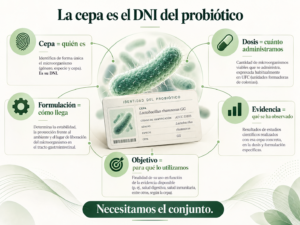
The strain is the probiotic’s ID card, but an ID card doesn’t tell the whole story
We can keep a simple comparison in mind.
The strain works in a way like the specific identity of the microorganism.
It tells us who we’re talking about.
But knowing a person’s identity doesn’t automatically tell us:
- what they can do;
- how much they work;
- under what conditions;
- or what results they will achieve.
Something similar happens with a probiotic.
The strain answers:
Who is it?
The dose answers:
How much are we giving?
The formulation:
How does it get there?
The evidence:
What has been observed?
And the purpose:
What are we using it for?
We need the whole picture.
That’s why strain identification is essential for many analyses.
But it should never become the only quality criterion.
In summary
If you only remember seven ideas, make them these:
- A probiotic can be identified by genus, species and strain, plus subspecies where relevant.
- The strain identifies a specific microorganism within a species.
- Two strains of the same species can have genetic and functional differences.
- That’s why results obtained with a specific strain should not automatically be extrapolated to any strain of the same species.
- This doesn’t mean every mechanism is exclusive to one strain: certain functions can be shared between different microorganisms.
- Correctly identifying the strain makes it easier to link product, research, dose and safety.
- The strain is essential for assessing many probiotics, but it must be analysed together with dose, viability, formulation and evidence.
Perhaps next time you see the words:
“Contains Lactobacillus”
you’ll ask yourself a question you didn’t ask before:
“Yes, but which one?”
That small question can tell us a great deal about the quality of the information in front of us.


Recent Comments