

When should you take probiotics: morning, night, with food or on an empty stomach?
You’ve chosen a probiotic.
You read the label and a new question comes up:
When should I take it?
In the morning.
Before breakfast.
With a meal.
After.
At night.
On an empty stomach.
If you look for the answer online, you’ll probably find every one of these options defended as if it were the only right one.
And that alone should make us suspicious.
The reality is that there is no universal best time for all probiotics.
The most suitable moment may depend on the microorganism, the formulation, whether the product has some kind of protection against the gastrointestinal environment, the food it’s taken with, and even why it’s being used.
And there is something even more important:
Getting more microorganisms to survive their passage through the stomach is one thing; showing that taking the product at that time produces a greater clinical benefit is another.
We shouldn’t confuse the two.
So instead of giving you a rigid rule, let’s understand what we know, what we don’t know and how to make a sensible decision.
The short answer: when is the best time to take a probiotic?
If the manufacturer gives specific instructions, the first recommendation is to follow them.
There is not enough evidence to say that all probiotics should be taken:
- in the morning;
- at night;
- on an empty stomach;
- or after eating.
There is experimental research suggesting that certain unprotected probiotic bacteria may survive better when taken with a meal or shortly before it, probably because food temporarily changes conditions in the stomach.
But that result can’t be automatically extrapolated to every product, strain or formulation.
So the practical order would be:
- Check the product’s instructions.
- Check which microorganisms and formulation it contains.
- Follow the regimen used if there is specific evidence for that product.
- If there’s no special instruction, choose a time you can stick to consistently.
In many cases, taking it properly every day may matter more than obsessing over finding the perfect minute.
Why might the timing of a probiotic matter?
Because we are taking live microorganisms.
Before reaching the gut, they have to pass through a fairly hostile environment.
Obstacles include:
- stomach acid;
- digestive enzymes;
- bile salts;
- changes in pH;
- gastrointestinal transit time.
Not all microorganisms tolerate these conditions in the same way.
Some strains are naturally quite resistant.
Others are more sensitive.
And the formulation can also protect them.
That’s why two apparently similar products can behave differently once swallowed.
The aim isn’t simply to put millions of microorganisms into your mouth.
We want an adequate amount of viable microorganisms to reach the place where they can perform the function they were studied for.
And food can play a part in that.
What about stomach acid?
The stomach maintains an acidic environment that has important functions, including helping with digestion and making it harder for certain microorganisms we swallow to survive.
But gastric pH doesn’t stay exactly the same throughout the day.
When we eat, food can temporarily change conditions in the stomach contents.
This led to research into a logical question:
Do certain probiotic bacteria survive better if taken close to a meal?
One of the most cited studies on this question used an in vitro model simulating the upper gastrointestinal tract.
The researchers analysed a formulation containing four microorganisms and compared their survival when given:
- before eating;
- with a meal;
- after eating;
- and with different foods or drinks.
In that model, the bacteria studied survived better when given with the meal or about 30 minutes before, while survival was lower when they were given 30 minutes after.
They also observed differences depending on the food matrix.
At first glance it might seem we have the answer:
“All probiotics should be taken 30 minutes before eating.”
But no.
Why that study does NOT mean we should all take them 30 minutes before eating
Because we need to understand what it actually investigated.
It was an:
in vitro study.
In other words, it used a model that tries to reproduce certain conditions of the digestive system.
It was not a trial in which thousands of people took the same probiotic at different times to see who got better health outcomes.
In addition, it studied:
- one specific formulation;
- with specific microorganisms;
- without the result being automatically applicable to any strain;
- and mainly assessing survival during gastrointestinal transit.
The result is useful.
It helps us understand that food can change the survival of certain probiotic bacteria.
But there is a big leap between saying:
“More microorganisms survived in a gastrointestinal model.”
and saying:
“Taking any probiotic exactly 30 minutes before breakfast gives better clinical results.”
The second statement requires additional evidence.
This is exactly the kind of nuance we want to keep in all our content.
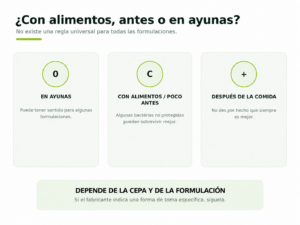
So is it better to take probiotics on an empty stomach?
Not necessarily.
The usual explanation for recommending probiotics on an empty stomach is:
“Since there’s no food, they’ll get to the gut faster.”
But speed isn’t the only factor.
An empty stomach may have different acidity conditions from those during a meal.
And certain bacteria may be sensitive to an acidic environment.
So “empty stomach = better survival” can’t be used as a universal rule.
Some formulations may be specifically designed to be taken on an empty stomach.
Others are recommended with food.
Others may use technologies that protect the microorganisms as they pass through the stomach.
Again:
the formulation matters.
If the manufacturer has studied its product given in a particular way and recommends that regimen, it makes more sense to follow it than to replace it with a rule found online.
And with food?
For certain bacterial probiotics it may make sense.
Food can temporarily buffer the acidic conditions of the stomach and change gastrointestinal transit.
In the experimental study we discussed, bacterial survival was higher when the product was given with the meal or shortly before.
But that doesn’t mean we should take a probiotic with any food to necessarily increase its effectiveness.
The same study found differences between different food matrices.
And there are other factors:
- strain;
- capsule;
- microencapsulation;
- formulation;
- acid resistance;
- stability;
- starting amount of microorganisms.
That’s why the question:
“With or without food?”
can’t be separated from:
“Which product are we talking about?”
Is it better before, during or after a meal?
If your product clearly states a regimen, follow that regimen.
If there is no specific instruction, the available evidence doesn’t allow us to set a universal minute for all formulations.
As a general guide, the available experimental data make it more reasonable to consider with a meal or shortly before for certain unprotected probiotic bacteria than to assume that taking them long after eating is always better.
But we wouldn’t turn this into a rigid recommendation.
Especially because there are products:
- with resistant coatings;
- that are microencapsulated;
- formulated in specific matrices;
- based on microorganisms with different tolerances.
A good product should be able to explain how it recommends you take it.
Morning or night?
This is probably the question that seems simplest and for which a universal rule makes the least sense.
There is currently no general recommendation from bodies such as the NIH stating that probiotics should always be taken in the morning or always at night.
Up-to-date NIH information focuses much more on:
- strain;
- product;
- dose;
- duration;
- storage;
- and purpose of use.
So:
8 in the morning is not a biologically magic time for all probiotics.
Nor is 10 at night.
If the product’s regimen is one dose a day with no specific condition regarding food, we can choose a time that makes it easier to keep up the habit.
For example:
- with breakfast;
- with a regular meal;
- or linked to another daily routine.
Consistency has a huge practical advantage:
it stops us forgetting a dose.
So does consistency matter more than timing?
In many cases, from a practical point of view, yes, it may matter more than debating between 8:00 and 22:00.
But we need to understand this sentence properly.
We are not saying:
“Timing never matters.”
We are saying:
“If there is no specific regimen requiring a particular time, sticking to the protocol properly is probably more useful than constantly changing the time in search of a theoretical optimisation.”
If you are meant to take a dose every day and one morning you take it with breakfast, the next day on an empty stomach, then forget it for two days and finally double the amount “to make up for it”, we have a much bigger problem than deciding whether 8:30 was better than 9:00.
Adherence is part of any regimen.
What about gastro-resistant capsules or protection systems?
Here we can see why universal rules fail.
One of the challenges with probiotics is getting enough microorganisms to survive gastrointestinal transit.
That’s why there are formulation technologies designed to protect them.
Depending on the product, these may include:
- capsules with specific coatings;
- microencapsulation;
- protective matrices;
- release technologies;
- selecting microorganisms resistant to certain conditions.
Research on delivery systems shows that the way the microorganism is presented can change its survival during gastrointestinal transit.
This means the right recommendation for a freeze-dried bacterium in a conventional capsule doesn’t have to be the same as for another formulation designed to withstand the stomach environment.
Again:
We are not just taking a strain.
We are taking:
strain + dose + formulation.
And if the probiotic is a yeast?
Another reason not to treat all probiotics as if they were the same.
Not all of them are bacteria.
There are yeast-based probiotics, such as certain strains of Saccharomyces boulardii.
Their behaviour in the gut environment and towards certain medicines may differ from that of bacterial probiotics.
In the in vitro study on meals we discussed, S. boulardii was less sensitive than the bacteria studied to differences related to meal timing.
That brings us right back to the same point:
the specific microorganism matters.
What if I’m taking antibiotics?
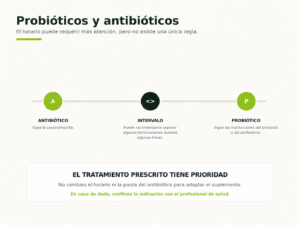
Here timing may matter even more.
Antibiotics are designed to affect susceptible microorganisms.
So if we take a bacterial probiotic that is susceptible to the antibiotic at the same time, its viability may be reduced.
That’s why it is often recommended to space certain probiotic bacteria apart from the antibiotic.
A gap of roughly two hours or more is often used as a practical measure, although the evidence defining the exact interval is limited and depends on both the antibiotic and the microorganism. Professional drug interaction sources also use this cautious recommendation.
In addition, a review published in 2026 again shows that the probiotic-antibiotic interaction is much more complex than a simple timing rule: different microorganisms show different sensitivity depending on the antibiotic and their biological characteristics.
So we wouldn’t write:
“Always take the probiotic exactly two hours after the antibiotic.”
We prefer:
If you use a probiotic during a course of antibiotics, check the product’s instructions and ask your healthcare professional. For certain bacterial formulations, spacing the two a few hours apart may be recommended.
And there is an even more important rule:
don’t change the timing or regimen of the antibiotic to fit in the supplement.
The prescribed treatment comes first.
Do all probiotics need to be spaced apart from antibiotics?
Not necessarily.
A yeast such as Saccharomyces boulardii, for example, is not a bacterium, and antibacterial antibiotics don’t act on it in the same way.
There are also bacteria with different sensitivity profiles to different antibiotics.
The 2026 review on antibiotic-probiotic compatibility stresses that the answer may depend on:
- species;
- strain;
- the antibiotic’s mechanism of action;
- metabolic state;
- the microorganism’s structural characteristics;
- and the ecological context of the gut.
That’s why talking about:
“probiotic + antibiotic”
without knowing what both products are gives insufficient information.
Should you start the probiotic during or after the antibiotic?
This question doesn’t have a single answer either.
Certain strains have been studied to reduce the risk of antibiotic-associated diarrhoea, and in those studies the start time may matter.
The NIH update of April 2026 notes that some strains might help reduce the risk of antibiotic-associated diarrhoea and highlights that the results are particularly favourable when the probiotic is started within the first few days of antibiotic treatment.
But this doesn’t mean:
“Everyone who takes antibiotics needs a probiotic.”
Nor:
“Any probiotic will do.”
Once again we need:
strain + dose + context + evidence.
This topic deserves its own article, and it’s best not to turn this guide on timing into a universal medical regimen.
Can I take my probiotic with other supplements?
It depends on what those supplements contain.
There is no universal incompatibility between “probiotics” and “supplements”.
But a person may be taking:
- minerals;
- vitamins;
- fibre;
- prebiotics;
- plant extracts;
- medicines;
- antacids;
- antibiotics;
- antifungals;
- other products.
So if you use several supplements or medicines at the same time, it’s a good idea to review them all together rather than looking at each product in isolation.
This is especially important when there is long-term medication or medical treatment.
The question shouldn’t only be:
“What time do I take my probiotic?”
but also:
“What else am I taking at that time?”
And with coffee, juice or hot drinks?
The simplest option is usually to follow the product’s directions exactly.
If it should be taken with water, take it with water.
There’s no need to look for a more sophisticated vehicle.
Live microorganisms can be sensitive to certain environmental conditions, and some products are designed to be mixed into specific liquids while others are not.
That’s why we would avoid recommending in general:
“Mix it into hot coffee.”
or:
“Always add it to juice.”
without first checking the stability of the formulation.
The same rule wins again here:
the label before generic advice.
What should I do if I forget a day?
It’s best not to improvise by automatically doubling the dose.
If you miss a dose, check the product’s specific instructions.
With many supplements, trying to “make up” by taking double offers no advantage and may worsen tolerance.
In addition, AESAN and food supplement regulations require these products to state a recommended daily dose and warn that it should not be exceeded.
The right idea is simple:
a bigger amount doesn’t magically make up for lost time.
How long should you take a probiotic for?
Although this is a different question from “what time”, it usually comes up straight after.
There’s no universal duration either.
The NIH notes that there are currently no general official recommendations for probiotic use in all healthy people and recommends discussing with a professional:
- which product;
- what dose;
- and for how long.
An intervention studied for two weeks shouldn’t automatically become:
“You have to take it for life.”
And a product designed for daily use doesn’t necessarily produce a noticeable benefit after a single dose.
Duration is part of the protocol, just like dose.
A practical guide: which time to choose
We can sum up all of the above in a short decision sequence.
If the label states a specific time
Follow it.
Especially if the formulation has been studied that way.
If it says “with food”
Take it with one of your usual meals.
Always choosing the same one can make consistency easier.
If it says “before meals”
Roughly respect the interval given by the manufacturer.
There’s no need to turn 30 minutes into exactly 29 minutes unless there are specific instructions.
If it says “on an empty stomach”
Follow the definition and instructions provided with the product.
Don’t extrapolate that regimen to other probiotics.
If it doesn’t say anything about meals
There’s no universal rule.
You can use a simple, repeatable time and ask the manufacturer or a professional if you want to understand the reasoning behind the formulation.
If you’re taking antibiotics
Don’t change the antibiotic regimen.
Check which probiotic you are using and ask whether it should be spaced apart.
If you take several medicines or have a significant medical condition
Ask for advice before putting together your own supplement schedule.
Seven common mistakes with probiotic timing
Mistake 1. “They should all be taken on an empty stomach”
No.
It depends on the strain and formulation.
Mistake 2. “They should all be taken with food”
Not that either.
There are products designed with different regimens.
Mistake 3. “They work better at night because the gut is resting”
We have no general recommendation that allows us to say this for all products.
Mistake 4. “They work better in the morning because the stomach is empty”
An empty stomach doesn’t automatically mean better survival.
Mistake 5. “If I forget, I’ll take two tomorrow”
We shouldn’t automatically exceed the recommended dose.
Mistake 6. “All probiotics must be spaced exactly two hours from the antibiotic”
It’s a practical recommendation used for certain bacteria, not a universal law that applies to all microorganisms and antibiotics.
Mistake 7. Looking for the perfect time and ignoring everything else
This is probably the most important mistake.
A perfect schedule won’t fix:
- a poorly chosen strain;
- an inadequate amount;
- a badly stored product;
- microorganisms that have lost viability;
- or a formulation with no evidence for the intended purpose.
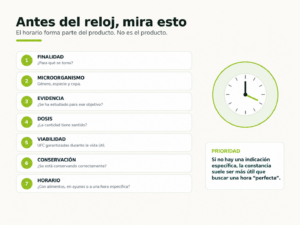
Timing is one part of the product. It isn’t the product.
What we should look at before the clock
If I had to set priorities, they would be these:
1. Purpose
What are we taking it for?
2. Microorganism
Which genus, species and strain does it contain?
3. Evidence
Has it been studied for that purpose?
4. Dose
Does it reasonably match the amount studied?
5. Viability
How many CFU are guaranteed throughout its shelf life?
6. Storage
Are we storing it correctly?
7. Regimen
With food, without food or at a particular time?
Timing is on the list.
But notice that it isn’t at the top.
So what is the best time?
The right answer may be less spectacular than you expected:
The best time is the one recommended for the specific formulation you are taking, and one you can stick to consistently.
For some unprotected bacteria there is experimental evidence of better survival with a meal or shortly before.
For other formulations that rule may not be necessary.
We don’t have enough basis to say that:
morning is always better than night.
Or that:
an empty stomach is always better than with food.
Or even that:
the same schedule works for all probiotics.
The question we need to drop is:
“What time do probiotics work?”
And replace it with a much better one:
“How should this specific probiotic be taken to respect its formulation and the evidence behind it?”
That’s when we start using probiotics with good judgement.
In summary
If you only remember seven things, make them these:
- There is no universal time to take all probiotics.
- The product’s specific instructions take priority over generic rules found online.
- Certain probiotic bacteria have shown better experimental survival with food or shortly before, but this does not show a universal clinical advantage.
- Morning versus night is usually less important than strain, dose, formulation, storage and consistency.
- Taking a probiotic on an empty stomach does not automatically guarantee better survival.
- If used during antibiotic treatment, certain bacterial formulations may need to be spaced a few hours apart, but this should be assessed according to the microorganism and the antibiotic.
- The aim shouldn’t be to find “the perfect time”, but to use the right product correctly.


Recent Comments