
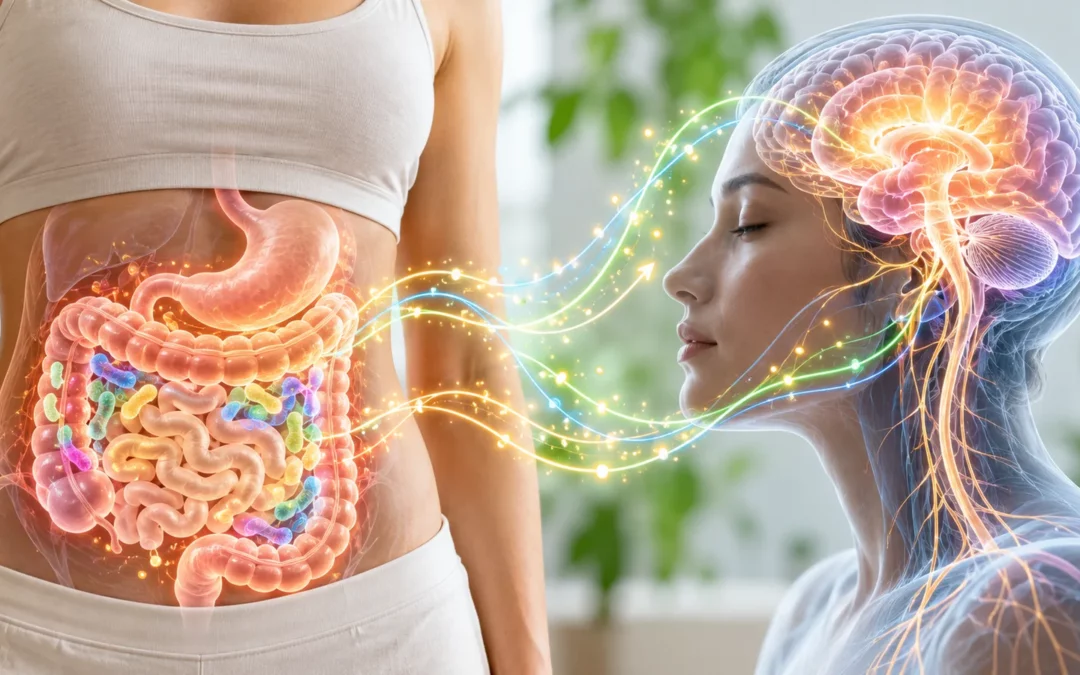
Gut-brain axis: what is it and how do the digestive system and the brain communicate?
“I couldn’t eat a thing, I was so nervous.”
“When I’m stressed, my bowels play up.”
“My tummy hurts before an exam.”
“I can feel it in my stomach.”
Long before we talked about microbiota, psychobiotics or neurogastroenterology, we had already noticed something obvious:
what happens in our brain can be felt in our gut.
Today we know that this communication also works the other way round.
The digestive system constantly sends information to the central nervous system about what is happening inside it: nutrients, distension, gut activity, and hormonal, immune and metabolic signals.
And the huge community of microorganisms living in our gut also takes part in this conversation.
This is where a concept you have probably heard of comes from:
the gut-brain axis.
Or, when we specifically include the role of microorganisms:
the microbiota-gut-brain axis.
But we need to set a limit right from the start.
The fact that the gut, the microbiota and the brain are connected does not mean that gut bacteria control our emotions like a remote control.
Nor does it mean that any change in the microbiota causes anxiety, depression, ADHD, autism or a neurological disease.
The communication exists.
The biological mechanisms are fascinating.
But turning this science into clinical conclusions requires a lot more evidence.
Let’s separate one thing from the other.
The short answer: what is the gut-brain axis?
The gut-brain axis is a two-way communication network between the gastrointestinal tract and the central nervous system.
There is no single cable connecting the two organs.
Information travels through different pathways that work at the same time:
- the autonomic nervous system;
- the enteric nervous system;
- the vagus nerve;
- gut hormones;
- the hypothalamic-pituitary-adrenal axis;
- the immune system;
- metabolites;
- the gut barrier;
- and signals related to the microbiota.
Current research sees this communication as a true network that integrates signals from the outside world, such as food, with the internal state of the body.
The key word is:
two-way.
The brain can change how the digestive system works.
And the gut can send information capable of influencing brain circuits.
This connection did not begin with the discovery of the microbiota
Sometimes it seems as if we discovered the gut-brain axis ten years ago.
That is not the case.
We have long known that the nervous system regulates:
- gut motility;
- secretions;
- digestive blood flow;
- appetite;
- the sensation of nausea;
- perception of visceral pain;
- the stress response.
What has changed in recent decades is our understanding of the additional role the microbiota may play.
That is why the expression microbiota-gut-brain axis is used more and more today.
A 2025 review in Nature Reviews Microbiology describes this interaction as a network in which the gut sends information to the brain and the brain, in turn, can change the gut environment and the function of the microbiota.
We are not replacing the gut-brain axis with bacteria.
We are adding a new layer to a communication that already existed.
First pathway: the enteric nervous system
Our digestive system has its own extensive network of neurons.
It is the enteric nervous system.
It is built into the wall of the gastrointestinal tract and takes part in many digestive functions, including:
- coordinating gut movements;
- secretions;
- interacting with cells in the mucosa;
- processing information coming from the gut.
It is sometimes popularly called:
“the second brain”.
The expression helps convey the enormous complexity of the gut’s nervous system.
But it can be misleading if taken literally.
The gut does not think or make decisions like our brain.
What it does have is a sophisticated neural network that can control many local functions and communicate with the central nervous system.
And that is where one of the main links between the two comes in.
Second pathway: the vagus nerve
The vagus nerve is probably the best-known player when we talk about the gut-brain axis.
It is part of the autonomic nervous system and connects the brain to many organs in the body, including much of the digestive system.
Through its sensory fibres it can send the brain information about:
- distension;
- nutrients;
- gut hormones;
- inflammatory signals;
- the physiological state of the digestive system.
But we should avoid another overly simple picture:
“Bacteria talk directly to the brain through the vagus nerve.”
There is usually a whole chain of intermediaries.
Signals from the gut contents can be detected by specialised cells in the epithelium.
These include enteroendocrine cells, which can respond to nutrients and various chemical signals.
These cells release hormones and signalling molecules that can communicate with nearby nerve endings.
The 2025 review by Ohara and Hsiao highlights these connections between sensory cells in the gut and nerve fibres as a central part of gut-brain communication.
It is not simply:
bacteria → nerve → thought.
It is a network.
Third pathway: enteroendocrine cells and gut hormones
The gut also works as an important endocrine organ.
Along its epithelium there are cells that can detect what is happening inside the gut and release hormonal signals.
These include molecules such as:
- GLP-1;
- PYY;
- CCK;
- ghrelin;
- gut serotonin;
- among others.
These signals are involved in aspects such as:
- appetite;
- satiety;
- motility;
- secretions;
- metabolism;
- communication with nerve pathways.
Some can activate receptors on vagal fibres and send information to brain structures involved in metabolic regulation and eating behaviour.
And the microbiota can indirectly influence some of these systems through the compounds it produces.
This is where things start to mix:
food + microbiota + gut + hormones + nerves + brain.
That is why the axis is much more complex than a single signal.
Does the gut produce 90% of serotonin?
We need to stop here, because this is probably one of the most repeated phrases about the gut-brain axis.
It is common to read:
“90% of serotonin is produced in the gut, so happiness starts in your microbiota.”
The first part has a real basis.
Most of the body’s serotonin is produced in peripheral tissues, especially by the enterochromaffin cells of the gut.
But the conclusion that follows is misleading.
Serotonin produced in the gut does not normally cross the blood-brain barrier.
Peripheral serotonin and brain serotonin are therefore separate pools.
The brain makes its own serotonin.
That does not mean the gut, tryptophan metabolism and the serotonin system are completely disconnected.
The microbiota can interact with:
- tryptophan metabolism;
- enteroendocrine cells;
- vagal signalling;
- immune systems;
- other metabolites.
But saying:
“Produce more gut serotonin and you’ll have more serotonin in your brain”
does not describe the physiology correctly.
Fourth pathway: metabolites produced or modified by the microbiota
One of the most interesting ways the microbiota can take part in this network is through metabolites.
Gut microorganisms transform components that come from:
- food;
- gut secretions;
- bile acids;
- amino acids;
- other compounds.
In these processes they can produce or modify molecules that interact with our body.
Among the most studied are:
Short-chain fatty acids
Especially:
- acetate;
- propionate;
- butyrate.
They are mainly produced by the fermentation of certain carbohydrates and fibres.
They can be involved in:
- gut metabolism;
- barrier function;
- immune regulation;
- cell signalling.
Tryptophan metabolites
Tryptophan can follow several metabolic pathways.
The microbiota can take part in some of them and change the availability of certain metabolites related to immune and neural signalling.
Bile acids
Gut microorganisms can transform primary bile acids into various secondary metabolites that also act as signalling molecules.
Recent reviews consider short-chain fatty acids, bile acids and tryptophan-derived indoles among the main families of metabolites involved in research on the microbiota-gut-brain axis.
This does not mean all these compounds go directly into the brain.
They can act:
- locally in the gut;
- on immune cells;
- through peripheral receptors;
- on the gut barrier;
- or through signals that later reach the nervous system.
Again:
an indirect interaction does not mean an irrelevant one.
Fifth pathway: the immune system
The gut is one of the main places where the following interact:
- microorganisms;
- the epithelial barrier;
- the immune system.
The microbiota and its metabolites can influence various immune responses.
And immune signals can travel around the body and interact with the nervous and endocrine systems.
That is why some now even talk about the:
microbiota-gut-immune-brain axis.
A review published in 2025 highlights the immune system as one of the major communication routes between the microbiota and the brain.
Here, too, we should avoid jumping to conclusions.
Finding that:
“the microbiota changes an immune marker”
does not automatically show that:
“this change improves mood”.
There may be a long causal chain between the two that has yet to be shown.
Sixth pathway: the brain also changes the gut
So far we have talked a lot about:
gut → brain.
But remember:
the axis works in both directions.
The brain can change digestive functions through:
- the autonomic nervous system;
- the stress axis;
- motility;
- secretions;
- visceral perception;
- the immune response.
This explains something many people have experienced.
A stressful situation can come with:
- an urgent need to go to the toilet;
- loss of appetite;
- nausea;
- abdominal pain;
- changes in bowel habits.
This does not mean these symptoms are “imaginary”.
They are real physiological changes.
In some people, stress can change motility, visceral sensitivity and other gastrointestinal functions.
And those changes can also alter the environment in which the microbiota lives. Recent reviews describe how the autonomic nervous system and the hypothalamic-pituitary-adrenal axis can change motility, secretions and the gut environment.
So we could also write:
brain → gut → microbiota.
Stress and the gut: a perfect example of two-way communication

Imagine a very stressful situation.
Our body activates various responses designed to help it adapt.
These involve:
- the sympathetic nervous system;
- the hypothalamic-pituitary-adrenal axis;
- cortisol;
- various physiological mediators.
These responses can change gastrointestinal function.
In turn, a person who has:
- pain;
- bloating;
- diarrhoea;
- constipation;
- bowel urgency
may become more worried or stressed.
And so a loop appears:
stress → digestive symptoms → worry → heightened perception of symptoms.
This does not mean the problem is psychological.
It means the brain and the gut are connected.
In fact, there is a clinical category called:
disorders of gut-brain interaction.
Disorders of gut-brain interaction
The expression that used to be widely used was:
functional gastrointestinal disorders.
Today the Rome Foundation uses:
Disorders of Gut-Brain Interaction (DGBI).
These are conditions with chronic or recurrent gastrointestinal symptoms that may involve different combinations of:
- changes in motility;
- visceral hypersensitivity;
- mucosal function;
- the immune system;
- the microbiota;
- how the brain processes signals coming from the gut.
Irritable bowel syndrome is one of the best-known examples.
This matters because it shows that talking about gut-brain interaction does not belong only to alternative medicine or supplement marketing.
It is part of modern gastroenterology.
But nor does it mean that every DGBI is caused by:
“an unbalanced microbiota”.
The pathophysiology is multifactorial.
Can the microbiota influence our mood?
This is the area that attracts the most interest.
The correct answer today would be:
there are biological reasons and experimental data suggesting that the microbiota is involved in systems related to stress, behaviour and brain function, but we are still learning how to turn that knowledge into reliable clinical interventions in humans.
There are results from:
- germ-free animals;
- microbiota transfer;
- antibiotics;
- dietary changes;
- probiotics;
- prebiotics;
- observational studies in humans;
- clinical trials.
But much of our mechanistic understanding still comes from animal models.
An extensive review published in 2025 on the gut-immune-brain axis expressly warns that much of what we currently know about these mechanisms comes from preclinical models.
And this matters a great deal.
A mouse that shows a certain behaviour after its microbiota is changed does not prove that a supplement treats anxiety in a person.
Association does not mean causation
Imagine we analyse two groups:
people with depression
and:
people without depression.
We find differences in certain bacteria.
What can we conclude?
That there is an association.
But we still don’t know:
Did the microbiota contribute to the problem?
Did the illness change diet and lifestyle, which then changed the microbiota?
Did medication play a part?
Did stress change both?
Are there variables we haven’t measured?
All of these can happen at the same time.
That is why headlines like:
“The depression bacterium has been discovered”
should make us suspicious.
Human biology rarely works so simply.
What are psychobiotics?
This term is being used more and more.
It was originally proposed to describe probiotic microorganisms which, when given in adequate amounts, might produce mental health benefits through interactions with the microbiota-gut-brain axis.
Since then, part of the literature has broadened the concept to include certain interventions aimed at the microbiota.
It is a fascinating field of research.
But also a very young one.
There are studies on specific strains and combinations in relation to:
- stress;
- anxiety;
- mood;
- cognition;
- sleep.
The results are interesting in some cases, inconsistent in others, and still not enough to treat “psychobiotic” as a synonym for psychological or psychiatric treatment.
The NCCIH itself has pointed out that results from probiotic trials are inconsistent and that factors such as diet, age, lifestyle and baseline microbiota can change how people respond.
So:
psychobiotics are a line of research.
Not a licence to promise:
“this probiotic treats anxiety.”
That leap is not justified.
So can we “improve the brain” by improving the microbiota?
The question is the wrong one.
Our microbiota does not work like an app we can upgrade to a better version.
Nor can we define a single microbiota that is optimal for the brain.
What we do know is that habits that support general health also interact with this system:
- a varied diet;
- enough fibre;
- physical activity;
- sleep;
- stress management;
- responsible use of medicines;
- looking after digestive health.
We can care for the gut ecosystem.
But it would be an exaggeration to promise that changing a specific bacterium will make it possible to:
- think better;
- get rid of anxiety;
- automatically improve mood;
- prevent neurological diseases.
Research still has a long way to go before that level of personalisation is possible.

And what about probiotics?
Here we need to apply exactly what we learned in previous articles.
We don’t ask:
“Do probiotics improve the gut-brain axis?”
We ask:
Which strain or combination has been studied, at what dose, in which people, and what was the outcome?
Because different microorganisms can have different effects.
A product with ten strains does not automatically have ten times more ability to act on the axis.
And finding a study on one strain does not allow its results to be applied to every formula that contains the same species.
Research in this field needs to be especially rigorous because the commercial expectations are enormous.
Five myths about the gut-brain axis
Myth 1. “The gut is literally our second brain”
No.
It has an extremely complex nervous system, but it does not carry out the brain’s cognitive functions.
Myth 2. “90% of serotonin is made in the gut, so that is where our happiness is made”
No.
Most of the body’s serotonin is peripheral, but it does not cross the blood-brain barrier and is not directly the brain’s serotonin.
Myth 3. “If I have anxiety, my microbiota is out of balance”
We can’t make that equation.
Anxiety disorders involve multiple biological, psychological and environmental factors.
Myth 4. “Dysbiosis causes depression”
Associations have been observed between the microbiota and mood disorders.
Association is not automatically causation.
Myth 5. “An emotional-wellbeing probiotic can replace psychological or medical treatment”
No.
No food supplement should be used as a substitute for a necessary assessment or treatment.
When should you see a professional?
Digestive symptoms can change temporarily with:
- stress;
- diet;
- travel;
- infections;
- medication;
- changes in routine.
But it is a good idea to seek advice when symptoms are:
- persistent;
- severe;
- recurrent;
- clearly affecting your quality of life.
Especially if you notice:
- blood in your stools;
- unintentional weight loss;
- fever;
- significant pain;
- persistent diarrhoea;
- recurrent vomiting;
- ongoing changes in bowel habits.
In the same way, symptoms such as:
- severe anxiety;
- depression;
- panic attacks;
- significant sleep problems;
- significant changes in behaviour
should not automatically be put down to the microbiota.
They need a proper assessment.
The gut-brain axis may be part of the explanation.
It doesn’t have to be the whole explanation.

What makes the gut-brain axis fascinating is precisely its complexity
Science is forcing us to abandon an old way of thinking about the body:
isolated organs working independently.
The gut is not simply a digestive tube.
The brain does not live in isolation from the rest of the body.
The immune system does not work separately from either of them.
And the microbiota is not a passive community that simply takes up space.
They are all part of communication networks.
We have solid evidence that:
- the brain and the gut communicate in both directions;
- the autonomic nervous system is involved;
- the vagus nerve carries information;
- enteroendocrine cells detect signals in the gut;
- the immune system plays a part;
- microbial metabolites can take part in various pathways;
- the brain can change the gut environment.
What we are still trying to understand is:
how far we can deliberately change these pathways to achieve specific clinical benefits in people.
And that is the difference between:
science
and:
marketing.
The first accepts what it doesn’t yet know.
In summary
If you only remember eight ideas from this article, make them these:
- The gut-brain axis is a two-way communication network between the digestive system and the central nervous system.
- It involves nervous, endocrine, immune and metabolic pathways.
- The microbiota can take part through metabolites and its interaction with gut cells, the immune system and nerve pathways.
- The vagus nerve is an important pathway, but bacteria do not simply send direct messages to the brain.
- Much of the body’s serotonin is produced in the gut, but gut serotonin does not cross the blood-brain barrier.
- The brain also changes the gut: stress and emotions can alter motility, sensitivity and other digestive functions.
- There are associations between the microbiota and various neurological or psychiatric disorders, but association does not prove causation.
- Research on psychobiotics is promising, but it does not yet allow a supplement to become a universal treatment for anxiety, depression or other disorders.
Perhaps we can sum up the whole axis in one sentence:
The gut and the brain are constantly talking. What we are still learning is exactly what they say, through which pathways, and how far we can usefully step into that conversation.
That uncertainty doesn’t make the science any less interesting.
It makes it more real.


Recent Comments