
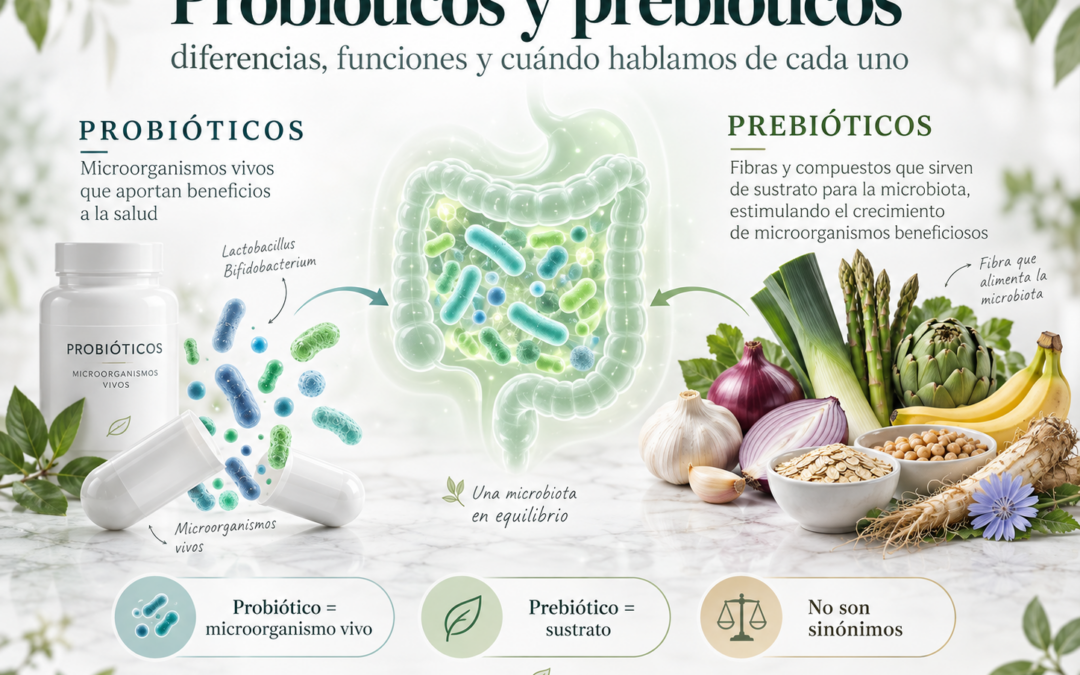
Probiotics and prebiotics: differences, functions and when we’re talking about each
Probiotic.
Prebiotic.
Two almost identical words that describe completely different things.
And to make things a bit more complicated, there are also synbiotics, fermented foods, fibre, live microorganisms and products that combine several of these concepts.
It’s no surprise we end up mixing it all up.
A very common explanation says:
“Probiotics are the good bacteria and prebiotics are their food.”
As a first approximation, it can help.
But scientifically it falls short.
Probiotics aren’t simply “good bacteria”, because they can also be other microorganisms and because a benefit has to be shown before they can be considered probiotics.
And prebiotics aren’t simply “food for bacteria” either.
To use that term correctly we need to show something much more specific: that certain microorganisms selectively use that substrate and that this interaction produces a health benefit.
So the fundamental difference is simple:
a probiotic provides live microorganisms.
a prebiotic provides a substrate that certain microorganisms use.
But behind this seemingly simple difference there is quite a lot more science.
Let’s understand it.
The short answer: what’s the difference between probiotics and prebiotics?
A probiotic is a live microorganism which, when given in an adequate amount, provides a health benefit.
A prebiotic is a substrate that is selectively used by host microorganisms and provides a health benefit.
The current scientific definition of a prebiotic was established through an international consensus led by ISAPP, and additional recommendations have since been published to specify what evidence should be required to correctly classify a substance as prebiotic.
We can sum it up like this:
| Probiotic | Prebiotic | |
| What is it? | A live microorganism | A substrate |
| Who acts? | The microorganism given | Mainly microorganisms that are already part of the host’s ecosystem |
| What does it need to show? | A health benefit at an adequate amount | Selective use by microorganisms + a health benefit |
| Can it be found in foods? | Yes, in certain foods that meet the criteria | Yes |
| Can it be found in supplements? | Yes | Yes |
| Is every live bacterium a probiotic? | No | — |
| Is all fibre prebiotic? | — | No |
This last row is especially important.
Not all fibre is prebiotic.
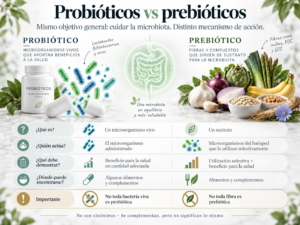
Probiotics vs prebiotics: the same general goal of caring for the microbiota, but a different mechanism of action.
First, let’s recall what a probiotic is
In the previous article we explained in depth what we should require in order to talk correctly about probiotics.
The central idea was this:
It isn’t enough to add microorganisms to a product.
We need to know:
- which microorganism it contains;
- genus;
- species;
- strain where relevant;
- amount;
- stability;
- storage conditions;
- and, above all, what evidence exists.
This matters because the effects of a probiotic can’t automatically be attributed to all microorganisms of the same species or to every product with the word “probiotic” on it.
A particular microorganism may have been studied for a specific situation.
Another may have different evidence.
And another may simply be present in a product without us having enough information to attribute the benefit we imagine to it.
That’s why, with probiotics, the specific microorganism we’re using matters a great deal.
But when we talk about prebiotics, the main character changes completely.
What exactly is a prebiotic?
ISAPP scientifically defines a prebiotic as:
a substrate that is selectively utilised by host microorganisms conferring a health benefit.
Let’s break this definition down, because every word matters.
1. It is a substrate
We are not necessarily giving microorganisms.
We are providing a substance they can use.
In the gut, some microorganisms have enzymes and metabolic abilities that let them make use of certain food components our own digestive system hasn’t fully digested.
2. There must be selective use
This is one of the key parts.
It isn’t enough for a substance to reach the colon and be fermented by any microorganism.
To talk about a prebiotic, there has to be selective use by certain host microorganisms.
And “selective” doesn’t necessarily mean:
“it only feeds one good bacterium.”
The microbiota is far too complex for that explanation.
A prebiotic can change the activity of different microorganisms, bacterial groups or microbial functions.
What matters is that there is a specific, demonstrable interaction with the microbiota.
3. That interaction must provide a benefit
This is probably the requirement most often forgotten in marketing.
A substance shouldn’t be called prebiotic in the scientific sense just because it increases a certain bacterium.
We also need to show a health benefit.
Scientific recommendations published in 2024 reinforced this criterion: to classify a substance as prebiotic, the substrate, its selective use and the benefit obtained in the target population must all be sufficiently characterised.
So:
“Increases bifidobacteria”
on its own shouldn’t be the end of the conversation.
The next question should be:
And what proven benefit does that change produce?
That’s a much more useful criterion.
So are prebiotics fibre?
Many are.
But fibre and prebiotic are not synonyms.
Most of the prebiotics studied so far belong to certain types of fibre or non-digestible carbohydrates.
The best-known examples include:
- inulin;
- fructooligosaccharides or FOS;
- galactooligosaccharides or GOS;
- oligofructose.
But there are many other types of dietary fibre that don’t necessarily meet the scientific criteria to be called prebiotics.
ISAPP explicitly explains that prebiotics are a particular category and that not all dietary fibres can be considered prebiotic.
This distinction is very important.
For example, we may eat a fibre that helps increase stool bulk or change its consistency.
That effect can be perfectly useful.
But it doesn’t automatically make that fibre a prebiotic.
To use that word, we need to show that the benefit is linked to its selective use by microorganisms.
Fibre and prebiotics: a simple comparison
We can picture the category “fibre” as a large family.
Within that family there are substances with very different characteristics.
Some hold water.
Others form gels.
Some are highly fermentable.
Others are hardly fermented at all.
Some produce certain changes in bowel transit.
And some also meet the requirements to be considered prebiotic.
So:
every fibre-based prebiotic belongs to a group of fibres.
But:
not all fibre is automatically prebiotic.
It’s like saying:
All electric cars are cars, but not all cars are electric.
The broad category and the specific category are not the same.
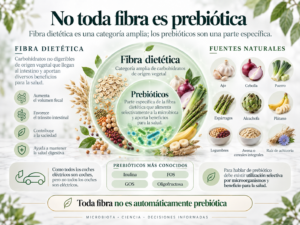
Not all fibre is prebiotic. Dietary fibre is a broad category; prebiotics are a specific part of it.
Where do we find prebiotics?
Certain components with prebiotic activity are found naturally in foods.
Foods that may provide varying amounts of these compounds include:
- garlic;
- onion;
- leek;
- asparagus;
- artichoke;
- chicory root;
- certain pulses;
- wholegrains;
- and some types of fruit, among others.
ISAPP lists foods such as garlic, onion, banana, wholegrains, pulses, chicory and artichoke among the usual food sources, although it points out that the concentration of prebiotic components can vary considerably.
This raises another important point:
eating a food that contains prebiotic components is not necessarily the same as taking a studied dose of an isolated prebiotic.
A food is a complex matrix.
It contains water, different fibres, carbohydrates, proteins, vitamins, minerals and many bioactive compounds.
A supplement or concentrated ingredient can provide a specific, measurable amount of inulin, FOS or GOS.
Both can be of interest.
But from a research point of view they are not exactly the same thing.
How do prebiotics work in the gut?
Imagine we eat a particular substrate that our digestive enzymes don’t fully break down.
Part of it reaches the large intestine.
There, certain microorganisms can use it.
During this process, microbial activity changes and various metabolites may be produced.
Among the best known are short-chain fatty acids, such as:
- acetate;
- propionate;
- butyrate.
These compounds can take part in various processes related to the gut environment and communication between the microbiota and the body.
But we need to avoid another oversimplification:
“The prebiotic reaches the gut and feeds the good bacteria.”
The microbiota works as an ecosystem.
When certain microorganisms use a substrate, they may produce compounds that others then use.
In microbiology this is called cross-feeding.
So changing the availability of a particular substrate can trigger a chain of interactions much more complex than directly feeding a single species.
And that’s exactly what makes it interesting.
We are not dealing with a tank full of isolated bacteria.
We are dealing with a community.
So is “feeding the good bacteria” wrong?
As a popular explanation, it can work.
As a complete scientific explanation, it doesn’t.
The main problem is automatically dividing gut microorganisms into:
good
and
bad.
Reality depends a lot on context.
Microorganisms that are normally part of our gut can behave differently depending on the environment, how abundant they are, the species alongside them and the host’s condition.
That’s why it’s more accurate to say:
Prebiotics provide substrates that certain microorganisms can selectively use, and this interaction must produce a proven benefit.
It’s a bit longer.
But much more accurate.
Probiotics and prebiotics act differently
At this point we can understand a fundamental difference.
When we take a probiotic
We temporarily introduce specific live microorganisms.
Depending on the strain and formulation, they can interact with:
- other microorganisms;
- the gut environment;
- the gut barrier;
- certain metabolites;
- and the host’s cells.
They don’t necessarily need to colonise the gut permanently to have an effect.
When we consume a prebiotic
We are not necessarily adding new microorganisms.
We are changing the resources available to microorganisms already in the ecosystem.
That difference is enormous.
One strategy introduces microorganisms.
The other changes the conditions that allow certain microorganisms to carry out their activity.
That’s why it doesn’t make much sense to ask:
“Which is better, a probiotic or a prebiotic?”
It would be like asking:
“Which is better, a seed or fertiliser?”
It depends on what we want to achieve.
They have different functions.
So is it worth taking both together?
Sometimes it may make sense.
And this is where another term comes in:
Synbiotic
A synbiotic combines live microorganisms and one or more substrates used by host microorganisms, and the combination must provide a health benefit.
The current international scientific consensus also distinguishes between complementary and synergistic synbiotics.
In a complementary synbiotic, its components can contribute to the benefit independently.
In a synergistic one, the substrate is specifically designed to support the activity of the microorganism in the same formulation.
This dismantles another commercial oversimplification:
“If I mix a probiotic with any fibre, I’ve got a better synbiotic.”
Not necessarily.
Putting ingredients together doesn’t guarantee a useful interaction between them.
Much less does it prove a benefit.
More ingredients don’t automatically mean a better formulation either.
The question remains the same:
What evidence is there for that combination and that amount?
Probiotic + prebiotic doesn’t automatically mean “double benefit”
It’s easy to see why it works commercially.
If one thing is good and another is too, putting them together seems bound to be better.
But nutrition doesn’t work by such simple addition.
One combination may be excellent.
Another may provide no additional benefit.
And another may even be less well tolerated by some people.
That’s why the criterion should be:
a formulation that makes sense + an adequate dose + evidence.
Not:
the number of ingredients.
It’s exactly the same problem we explained with multi-strain probiotic products.
A longer label may look more impressive.
Not necessarily more effective.
And fermented foods?
This is the third concept that often gets mixed up.
A fermented food is a food made through the controlled growth of microorganisms and the transformations they produce in its components.
Well-known examples are:
- yoghurt;
- kefir;
- certain cheeses;
- sauerkraut;
- kimchi;
- some fermented olives.
But a fermented food is not automatically probiotic.
It may contain live microorganisms.
It may have undergone interesting transformations during fermentation.
It may be a perfectly good part of a healthy diet.
But to call it probiotic in the scientific sense, it needs to contain specific microorganisms that meet the relevant criteria.
ISAPP explicitly distinguishes probiotics, prebiotics, synbiotics and fermented foods because they are not interchangeable categories.
So we can have:
fibre that isn’t prebiotic.
a fermented food that isn’t probiotic.
a live microorganism that isn’t probiotic.
a mix of fibre and microorganisms that isn’t necessarily a proven synbiotic.
This is probably one of the most useful ideas in this article.
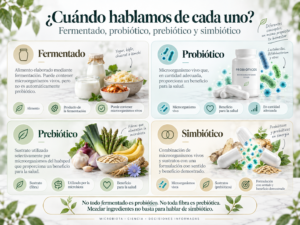
When do we talk about each one: fermented, prebiotic, probiotic or synbiotic?
How much fibre do we need?
Although fibre and prebiotics are different concepts, looking after your overall fibre intake is still important.
EFSA states that an intake of 25 grams of fibre a day is adequate for normal bowel function in adults.
That doesn’t mean 25 grams is a “dose of prebiotics”.
They are different things.
Nor does it mean we should go from eating very little fibre to very large amounts overnight.
Our digestive system and our microbiota need time to adapt.
When we rapidly increase certain fermentable carbohydrates or fibres, we may experience:
- wind;
- bloating;
- abdominal discomfort;
- changes in bowel habits.
The World Gastroenterology Organisation recommends increasing fibre gradually precisely to improve tolerance.
So once again:
more doesn’t always mean better.
Especially if “more” means all at once.
Does wind mean the prebiotic doesn’t agree with me?
Not necessarily.
Microbial fermentation can produce gas.
So some change in gas production when quickly increasing certain types of fibre or prebiotics is not surprising.
But intensity and tolerance vary enormously from person to person.
A slight temporary change is not the same as significant pain, severe bloating or persistent symptoms.
And context matters especially here.
People with irritable bowel syndrome or other digestive problems may tolerate certain fermentable carbohydrates very differently.
In fact, some prebiotics can be problematic for certain people when used in high amounts. Studies on inulin, FOS and GOS show that dose, type of substrate and individual characteristics all influence the response.
That’s why we shouldn’t recommend:
“Take lots of prebiotic fibre and put up with the wind because it means it’s working.”
That doesn’t make sense either.
Tolerance matters.
Food or a prebiotic supplement?
There is no universal answer.
For most people, a varied diet rich in plant foods is still the foundation.
Fruit, vegetables, pulses, wholegrains, nuts and seeds provide different types of fibre and many nutrients and bioactive compounds.
A supplement has a different feature:
it can provide a specific amount of a particular substrate.
That can be useful when there is a specific goal and a well-designed formulation.
But a supplement doesn’t turn a poor diet into an adequate one.
AESAN points out that food supplements should be used to complement the diet and not as a substitute for a balanced diet.
So the question should be:
“What do I need to achieve, and which option makes most sense in my situation?”
Not:
“Which supplement do I absolutely have to take?”
How to spot a prebiotic on a label
You won’t always find the word written in large letters:
PREBIOTIC
The ingredient name may appear directly instead.
The most common include:
- inulin;
- fructooligosaccharides (FOS);
- galactooligosaccharides (GOS);
- oligofructose;
- chicory fibre.
ISAPP lists these ingredients among the examples most recognisable to consumers.
But identifying the ingredient is only the first step.
Next we should ask:
How much does it contain?
A minimal amount included just so an ingredient can appear on a label doesn’t guarantee a meaningful effect.
What evidence is there?
Has that substrate been studied?
At that amount?
In people?
For what purpose?
What benefit is being claimed?
This is an especially important question.
An ingredient being considered prebiotic scientifically doesn’t mean any marketing phrase about it is authorised.
In Europe, health claims used on foods and supplements are governed by Regulation (EC) 1924/2006 and must meet the relevant conditions. AESAN points out that the messages used must be truthful, clear, reliable and useful to consumers.
Science and advertising are not exactly the same thing.
And we need to be able to tell them apart.
Five common mistakes about probiotics and prebiotics
Mistake 1. “All probiotics do the same thing”
No.
The effects may depend on the microorganism, strain, dose and purpose.
Mistake 2. “All fibre feeds the good bacteria and is prebiotic”
No.
Many fibres are beneficial without meeting the scientific criteria to be considered prebiotic.
Mistake 3. “If it has a probiotic + prebiotic, it’s automatically better”
No.
A combination needs to make sense and show a benefit.
Mistake 4. “The more prebiotic I take, the better”
No.
There is an individual response, and rapidly increasing certain fermentable substrates can cause discomfort.
Mistake 5. “If a product changes the microbiota, it’s already proven to improve my health”
This mistake is especially important.
Changing the amount of a bacterium or group of microorganisms is a microbiological outcome.
Improving a symptom, a function or a health-relevant parameter is a different outcome.
To talk about a prebiotic in scientific terms, we need to connect the two.
It’s not enough to show that:
“it changes the microbiota”.
We need to ask:
Does that change produce a proven benefit?
Probiotic or prebiotic? The questions we should really ask
Instead of deciding by the name of the category, we can start with these questions:
1. What do I want to achieve?
“Improving the microbiota” is not a precise enough goal for choosing just any product.
2. Am I introducing microorganisms or a substrate?
That tells us whether we’re looking at a probiotic or a prebiotic strategy.
3. What exactly does it contain?
If it’s a probiotic:
microorganism + strain + dose.
If it’s a prebiotic:
substrate + amount.
4. Is there evidence for that formulation and that purpose?
Not for “probiotics”.
Not for “fibre”.
For the specific ingredient or microorganism in front of us.
5. Do I tolerate it well?
A formulation that’s excellent on paper stops being useful if it causes significant discomfort or can’t be kept up.
6. Are there symptoms that should be assessed first?
If there is persistent pain, long-lasting diarrhoea or constipation, blood in the stools, unexplained weight loss or other relevant symptoms, the aim should be to understand what is going on.
Not to try to fix it simply by adding microorganisms or fibre.
The aim isn’t to take more “biotics”
Probiotics and prebiotics are fascinating tools because they let us interact with the microbiota through completely different strategies.
The first provide live microorganisms.
The second provide substrates that certain microorganisms can use.
And synbiotics try to combine both approaches.
But understanding these concepts should move us away from the idea that caring for the gut means collecting ingredients.
We don’t necessarily need:
more strains.
more CFU.
more fibres.
more prebiotics.
more supplements.
We need better judgement.
A varied diet is still the foundation.
And when we decide to use a specific strategy, we should be able to answer:
What does it contain?
In what amount?
Which microorganisms are involved?
What evidence is there?
What benefit do we expect?
Does it make sense for this person?
That approach is much less spectacular than saying:
“Feed your good bacteria.”
But it’s also much more useful.
In summary
If you only remember seven ideas from this article, make them these:
- Probiotics and prebiotics are not the same thing.
- A probiotic provides live microorganisms that, in adequate amounts, must show a benefit.
- A prebiotic is a substrate selectively used by host microorganisms that must provide a benefit.
- Not all fibre is prebiotic.
- Not every fermented food is probiotic.
- Combining a probiotic and a prebiotic doesn’t automatically guarantee a superior formulation.
- To assess any of these strategies, we need to know the ingredient or microorganism, dose, purpose, evidence and tolerance.
Perhaps the difference can finally be summed up simply:
A probiotic introduces certain microorganisms.
A prebiotic works mainly by providing resources to microorganisms that are already part of the ecosystem.
Two different strategies.
Two different tools.
And neither should be chosen simply because its name is fashionable.


Recent Comments